Australia looks to boost domestic mineral processing industry with $676 million fund
:format(auto):focal(center))
Australia aims to boost its processing and refining capabilities this decade, as part of a strategy to reduce its reliance on China and boost its economic share of the global battery supply chain.
The strategy aims to attract A$500 million ($338 million) of new investments into critical minerals projects, and establish a fund to provide A$1 billion ($676 million) for value-added projects.
Australia is the world’s largest lithium producer, third-largest cobalt producer, and also mines nickel, graphite and rare earths. Yet it mainly exports minerals to be processed in China. Increasing processing capability to produce chemicals such as lithium hydroxide and precursor materials will significantly add value, it said.
Australia exports lithium-rich spodumene rock, for example, but relatively few battery grade lithium chemicals. Benchmark’s Lithium Forecast shows that Australia is expected to mine 394,000 tonnes LCE, but produce only 11,000 tonnes LCE of lithium chemicals in 2023.
“We must look to grow our downstream capabilities in areas of competitive advantage by enabling more processing and refining of minerals onshore in Australia, and realise the benefits derived from value-adding to our resources,” Madeleine King, Australia’s Minister for Resources, said.
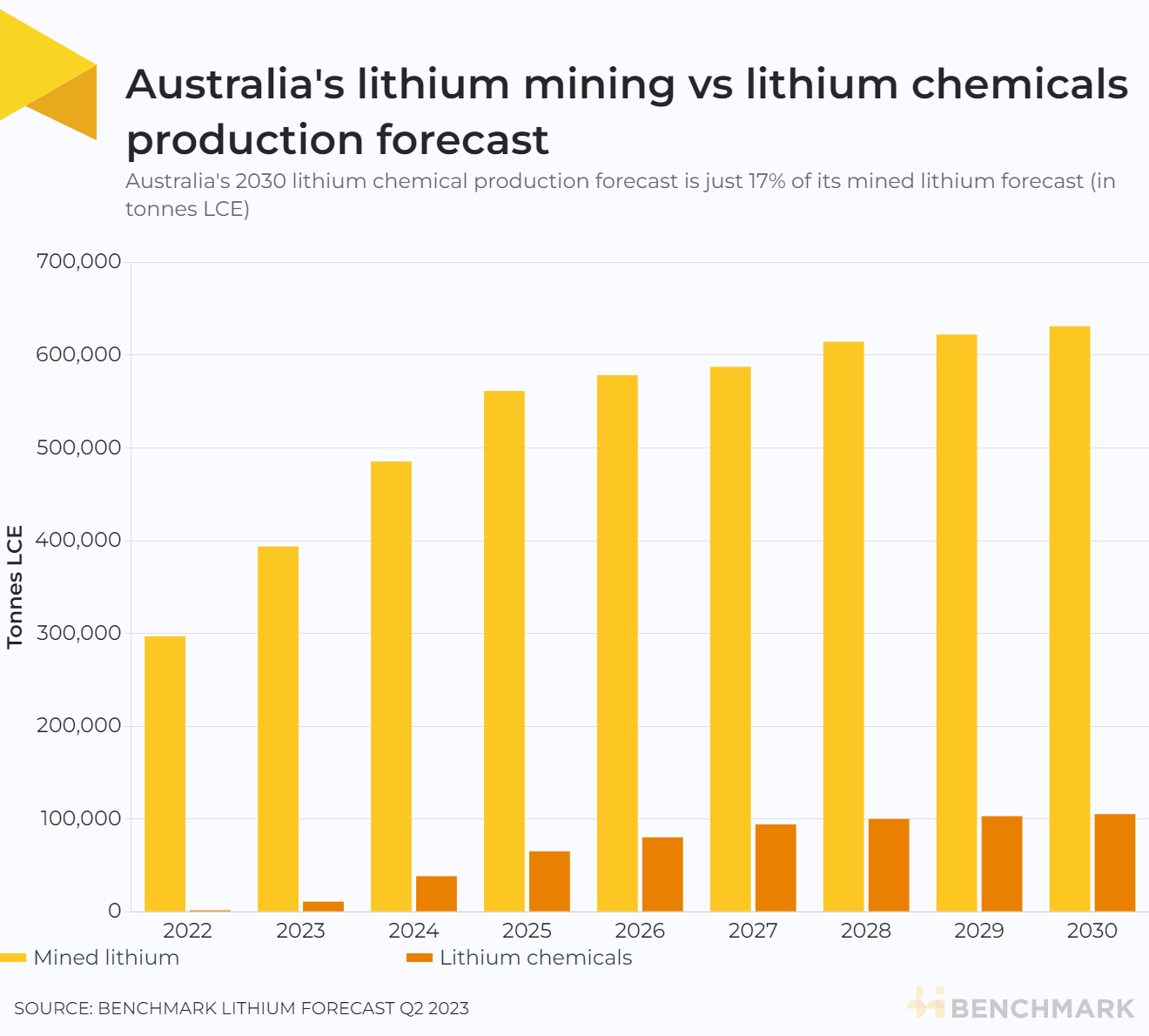
Critical mineral mining could add A$71.2 billion to Australia’s gross domestic production by 2040, but that could rise to A$133.5 billion if Australia builds downstream refining and processing capability, it said.
Australia will establish a National Reconstruction Fund, which will include A$1 billion for “value-add in resources” and A$3 billion for renewables and low emissions technologies. In addition the Northern Australia Infrastructure Facility will earmark A$500 million to support critical mineral projects.
Foreign support, sovereign supply
The strategy warned that given much of Australia’s minerals were already secured via offtakes, it could be hard to secure enough domestic resources for processing.
“Foreign companies are securing ownership and offtake arrangements for a large share of Australian minerals, particularly lithium and rare earth elements,” the strategy states. “In this context, Australian processors and manufacturers may struggle to access supplies of Australian minerals in future.”
Benchmark forecasts that 80% of Australia’s mined lithium production this year will have some level of Chinese involvement, though the strategy doesn’t explicitly state that Australia is concerned by Chinese companies.
Indeed, China is not mentioned once in the critical minerals strategy.
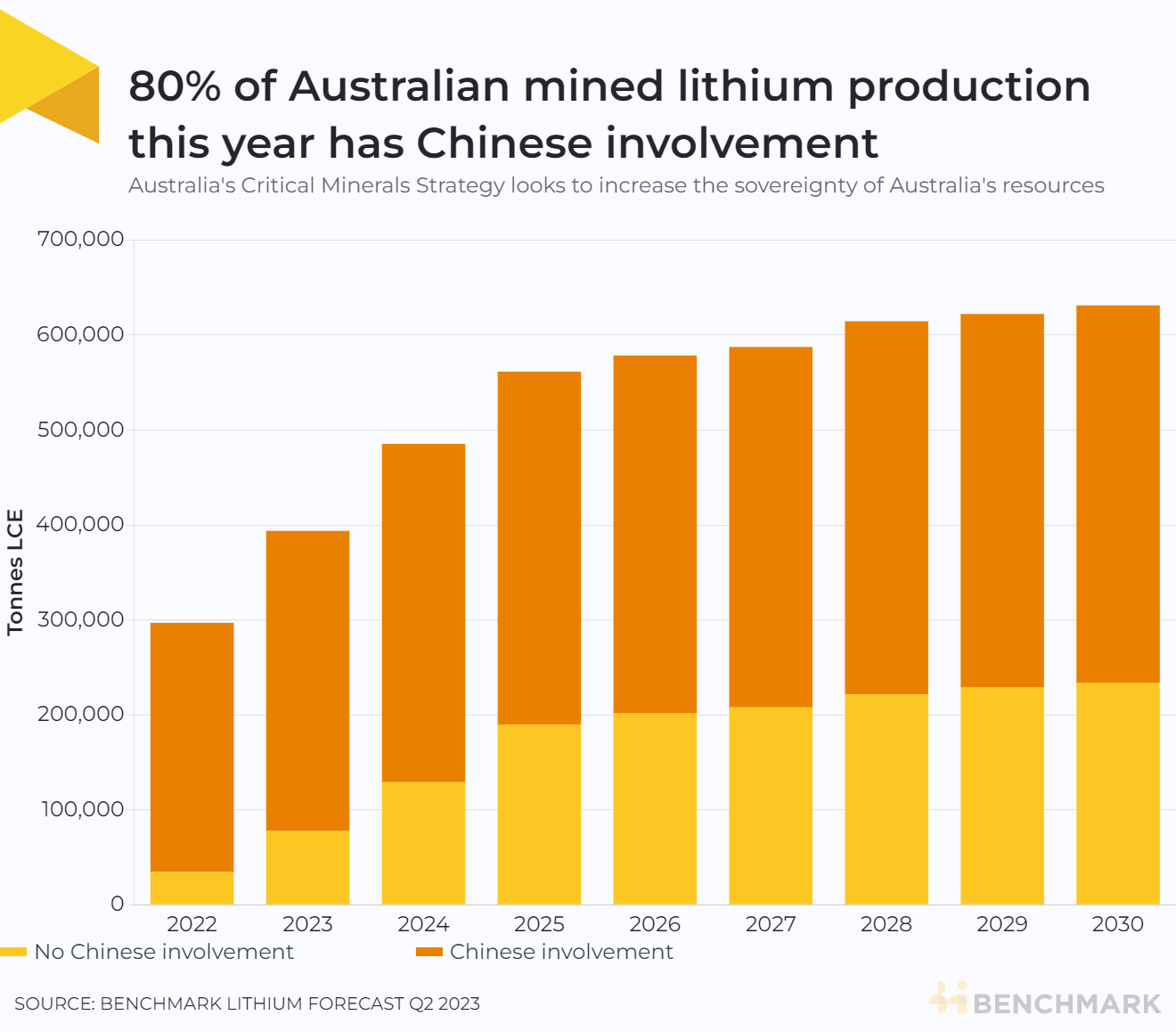
None of the lithium chemical production facilities in Australia’s pipeline are majority-owned by Australian companies.
Kwinana was the first lithium hydroxide refinery in Australia and is owned by a joint venture of which China’s Tianqi Lithium owns 51% and Australia’s IGO owns 49%. The refinery is associated with the Greenbushes lithium mine in Western Australia.
“Increasing Australia’s sovereign capability in mineral processing will involve moving beyond exporting ores and undertaking more concentration, separation, refining and smelting onshore,” the strategy states. “The fastest and most efficient way to build our downstream capability and get Australian projects into international supply chains is through investment from like-minded countries and global companies.”
Global partnerships
Australia is already partnered with several such countries. It has a Free Trade Agreement with the US, which allows US companies to access tax credits through using Australian minerals in their batteries.
Albemarle, a US-owned company, operates the Kemerton spodumene to lithium hydroxide refinery in Australia with an 85% stake. Australia-based Mineral Resources owns the other 15%. The refinery is currently undergoing commissioning.
Australia is also a founding member of the Minerals Security Partnership set up last year between several countries including Australia, the US, the UK and the European Commission which was developed to bring high-demand countries and high-supply countries together in the face of increasing Chinese dominance in the battery supply chain.
To further develop its international relations Australia is negotiating a free trade agreement with the EU alongside an economic cooperation agreement with India and an Indo-Pacific economic framework.
Through working with international partners, Australia hopes to tap into the expertise of foreign companies from countries aligned with its values.
“Australia can scale up downstream processing and manufacturing by encouraging collaboration with, and attracting investment from, global firms that have developed and proven their IP overseas,” the strategy says.
Government policy and strategic investment across the EV battery supply chain will be a core focus at this year’s Battery Gigafactories Asia Pacific 2023 in September in Tokyo, Japan.
Learn more about the agenda at Battery Gigafactories Asia Pacific 2023 and register to secure your place here.
For more information about the service this data draws from, get in touch
Want to read more analytical content?
Create a Free Account
Create a free Intelligence account to access 3 content pieces per month.