Global cell prices fall below $100/kWh for first time in two years
:format(auto):focal(center))
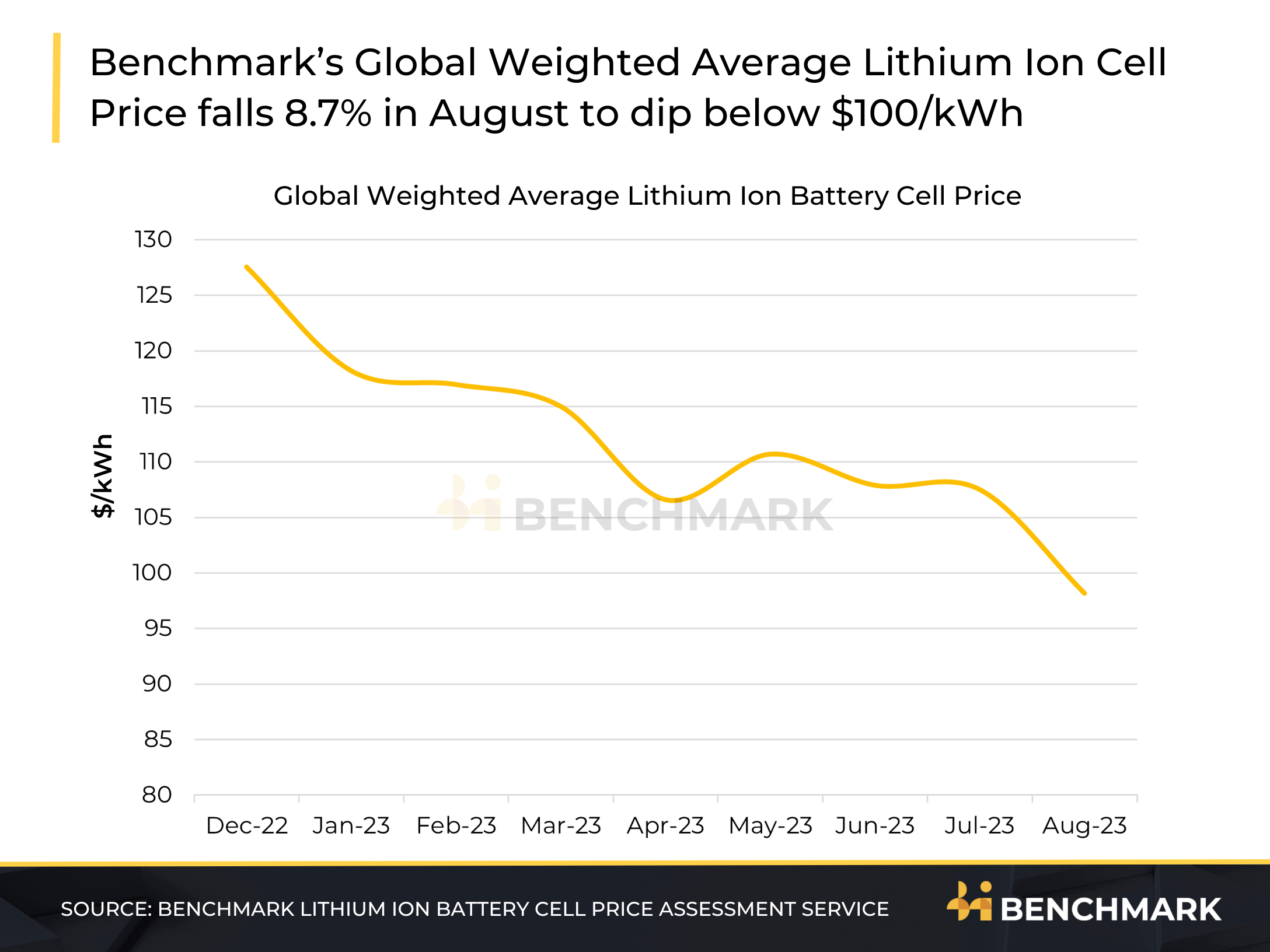
The global weighted average price for lithium ion cell prices has dropped below $100 per kilowatt-hour for the first time in two years on the back of falling raw material prices.
The latest average price from the Benchmark Lithium ion Battery Cell Price Assessment is $98.2/kWh, a 33% drop from the price in March last year which hit a high of $146.4.
For electric vehicles to reach price parity with internal combustion engine vehicles, battery pack prices need to reach $100/kWh, not accounting for subsidies. This corresponds to a cell price of around $80/kWh.
“Decreasing cell prices could allow OEMs to sell mass market EVs at comparable prices to ICE vehicles, with the same margin, improving the attractiveness of the EV transition for both consumers and automakers,” Evan Hartley, an analyst at Benchmark, said.
Falling raw material costs
The largest driver for this price drop is the fall in cost for all raw material inputs.
Falling prices of battery metals and graphite have followed through into falling cathode and anode prices. Benchmark’s Cathode and Anode indices have fallen 41.9% and 17.6% so far this year, respectively.
Lithium prices have more than halved since the start of 2023 with Benchmark’s Lithium Carbonate Price Index dropping 52% since the start of the year and the Lithium Hydroxide Price Index dropping 58%.
Cobalt sulphate prices are at their lowest level as recorded by Benchmark’s Cobalt Price Assessment in the China market. This has helped bring LCO prices to their lowest levels of $100.1/kWh in China and $123.6/kWh in the rest of Asia.
Nickel prices, too, are in decline with Chinese nickel sulphate prices dropping 25% so far this year.
The low nickel and cobalt prices, combined with lithium hydroxide prices falling faster than lithium carbonate prices have resulted in modelled prismatic NCM811 cell prices in China dropping to $82.6/kWh, lower than $85.7/kWh price for an equivalent LFP cell.
These are both increasingly close to the $80/kWh price point needed to reach a $100/kWh pack price.
Consequences of low prices
Notably, this is a global average indicating that the downward trend of cell prices is observed not just in China, but in Western markets, too.
“Falling cell prices are of particular concern for companies investing in cell production outside of China,” Hartley said. “Particularly when there is already concern surrounding the profitability of factories in regions such as Europe.”
Low raw material prices could also alleviate some cost pressures from other aspects of the cell manufacturing process, Hartley said, noting high electricity prices in Europe and increasing labour costs in the US.
“If the cost of the materials to make the batteries is less, these sorts of wider economic concerns are less significant in terms of raising the price of battery production,” he said.
This analysis is drawn from the detail in Benchmark’s Lithium Ion Battery Cell Price Assessment service – which covers all 7 major chemistries across all formats in each major region, providing transparency within the downstream supply chain.
To learn more about our Lithium Ion Battery Cell Price Assessment service – please provide your details here and our team will contact you shortly:
For more information about the service this data draws from, get in touch
Want to read more analytical content?
Create a Free Account
Create a free Intelligence account to access 3 content pieces per month.