Is 2024 the year of solid-state battery powered EVs?
:format(auto):focal(center))
Chinese automaker Nio has begun publicly testing semi-solid-state battery packs in some of its electric vehicles ahead of a full rollout planned for June.
The 150 kilowatt-hour (kWh) batteries are produced by WeLion, a Chinese solid-state battery developer. Towards the end of last year, Nio’s chief executive drove an electric vehicle (EV) fitted with WeLion’s battery pack on a live stream to demonstrate its capabilities.
Significantly, this marks the first case of an oxide-based solid-state battery in public use in an EV. The production of oxide solid electrolytes is challenging due to the brittle nature of the material which makes mass manufacture more difficult than other solid-state electrolytes.
“Seeing oxide-based technologies rolled out in China first is a huge moment for the industry,” Rory McNulty, a solid-state battery analyst at Benchmark, said.
Battery giant CATL recently said it was targeting 2027 for the small-scale rollout of its solid-state batteries.
What’s the difference between semi- and all-solid-state batteries?
The electrolyte in a semi-solid-state battery contains both a solid and a liquid component, with the liquid overcoming some of the interfacial challenges that an all-solid-state system faces, where no liquid is present.
“There are drawbacks of using a semi-solid-state system. Compatibility with next-generation electrodes, safety, and performance might be compromised to allow the inclusion of liquid for instance,” McNulty said. “That being said, it looks set that semi-solid-state batteries will be commercialised before all-solid-state batteries.”
Watch Benchmark Analyst Rory McNulty discuss the transition of next-gen battery companies from R&D to commercialisation.
What’s the significance of the anode material?
Robin Zeng, the chief executive of CATL, told the Financial Times that he believes solid-state batteries can only deliver on their promises if lithium metal is used as a next-generation anode material.
The development of such batteries is currently limited by the insufficient capacity to produce battery-grade lithium metal.
“Nio is still commercialising a solid-state battery with a traditional anode,” McNulty said. “The pack is 150 kWh, but the anode is a silicon-graphite composite anode, rather than the high content silicon or lithium metal anodes that have been promised.”
Does any country dominate the solid-state space?
China is a leader in solid-state battery production, though has yet to assert the level of dominance it holds in the traditional lithium ion industry.
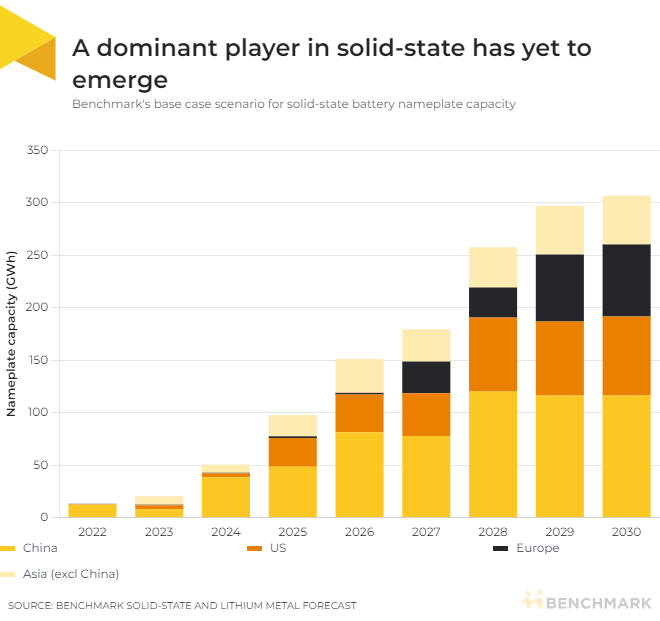
Benchmark’s Solid-State and Lithium Metal Battery Forecast, shows that China is currently on track to account for 38% of nameplace solid-state capacity in 2030. The US and Europe each account for around 25% of the 2030 nameplate capacity.
Earlier this year, China formed a coalition of solid-state battery players, including CATL and Nio, in order to encourage the build out of this nascent industry.
Nio’s test and subsequent rollout will be watched closely by all players in this developing market.
“If this proves that solid-state batteries can be manufactured on a gigawatt hour-scale, then that is a huge green flag for the rest of the world to drive ahead” McNulty said. “However, if these technologies fail fast, or are recalled, then that could swing sentiment in the other direction entirely.”
How is Nio testing the batteries?
The semi-solid-state battery packs will be randomly available at no extra cost to users of Nio’s EV rental service across China and deployed through its battery swapping stations.
“Battery swapping is a fantastic way to trial a new technology while being able to bring it back and run full diagnostics of performance and degradation,” McNulty said. “From a data collection perspective, you can’t beat it.”
Benchmark’s Solid State and Lithium Metal Batteries Forecasts provide a comprehensive view across the industry, examining supply and demand by region and producer out to 2040.
To learn more, please provide your details here and our experts will contact you shortly:
For more information about the service this data draws from, get in touch
Want to read more analytical content?
Create a Free Account
Create a free Intelligence account to access 3 content pieces per month.