Understanding emissions of lithium ion’s two mainstream chemistries NCM & LFP: New Data
:format(auto):focal(center))
Understanding the carbon footprint of producing LFP and NCM cells is becoming central to expanding lithium ion battery capacity for both cell formats.
Mid-nickel NCM and LFP cathodes have become the primary lithium ion battery routes of choice as the world expands from a forecasted 1 TWh of production in 2023 to over 6 TWh by 2033.
While other battery chemistries will play a part, the vast majority of batteries deployed in this energy storage revolution will be NCM or LFP.
Benchmark’s new Battery Emissions Analyser (BEA) service now sheds new light on the carbon emissions of both chemistries as billions of dollars of investment flow towards new supply chain capacity.
Understanding emissions today is key to improving how these new supply chains are built out over the next decade.
This includes new sources of nickel, lithium, and phosphate and new ways to improve or re-invent the way the industry processes these elements.
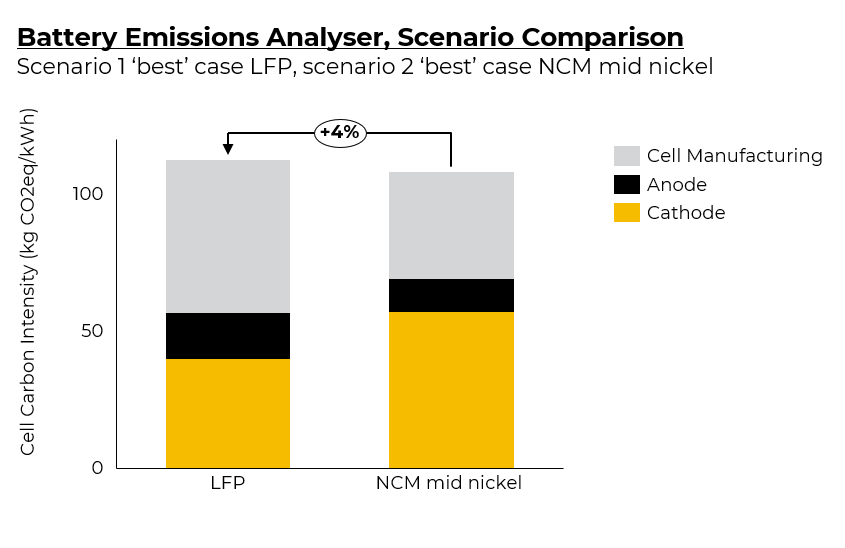
The Battery Emissions Analyser shows that the production of NCM mid-nickel has, at present, 4% lower emissions than LFP under the Scenario 1: the best case scenario for each cathode.
While LFP cells maintain a cost advantage over the majority of nickel-based chemistries, the carbon intensity of these variants can in fact prove more carbon intensive than NCM cells, despite the lack of cobalt and nickel.
LFP batteries require more active and inactive materials than NCM batteries on a kWh basis, due to their lower energy density. That means that to get to the same kWh level, the material intensity is higher resulting in higher emissions.
However, LFP batteries tend to last longer than NCM cells which will play into its lifetime emissions footprint.
Nickel sourcing will impact NCM competitiveness
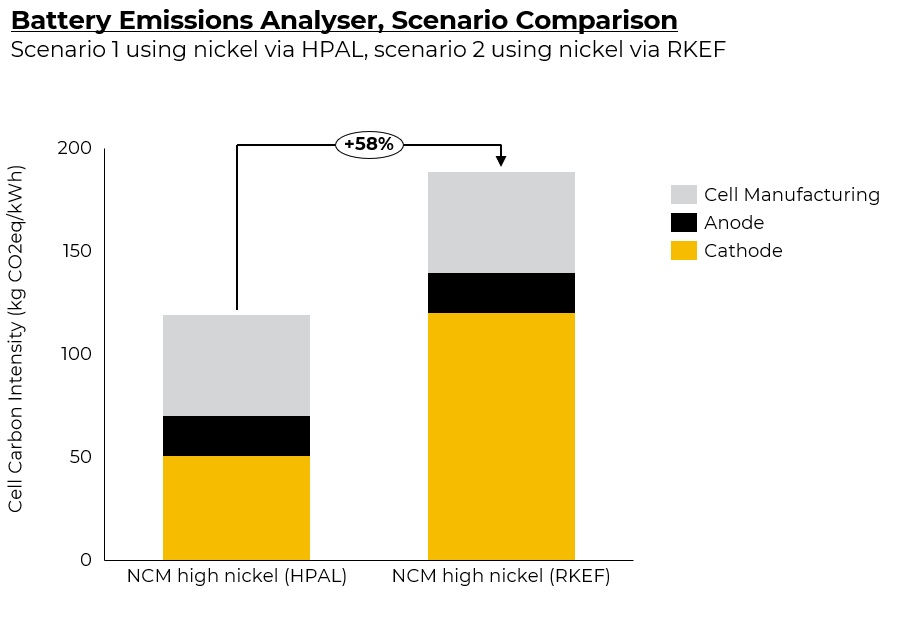
Deeper analysis shows that within mid and high nickel NCM batteries, the choice of nickel is significant, and can tip the balance of carbon competitiveness.
Sourcing nickel from RKEF processing (Rotary Kiln Electric Furnace) instead of HPAL (High Pressure Acid Leaching) resulted in an increase of 58% in carbon emissions at battery cell level.
In addition, the source of energy deployed during the cathode active material (CAM) production process has been shown to have a material impact on the realised carbon intensity.
The build out of energy storage capacity will be fundamental to the successful transition of energy generation to cleaner sources.
However, to date, there has been limited understanding of the impact of this battery production across battery technologies, much less across lithium ion chemistries due to a lack of understanding of real world material intensities and supply chain process routes.
“With regulatory pressure increasing, identifying risk hotspots is imperative to developing effective supply chain strategies for all downstream participants,” Charlotte Selvey-Miller, head of sustainability at Benchmark, said.
Benchmark’s Battery Emissions Analyser (BEA) assesses carbon intensity at battery cell level for the most common electric vehicle battery chemistries available today, using robust Life Cycle Assessment (LCA) methodologies.
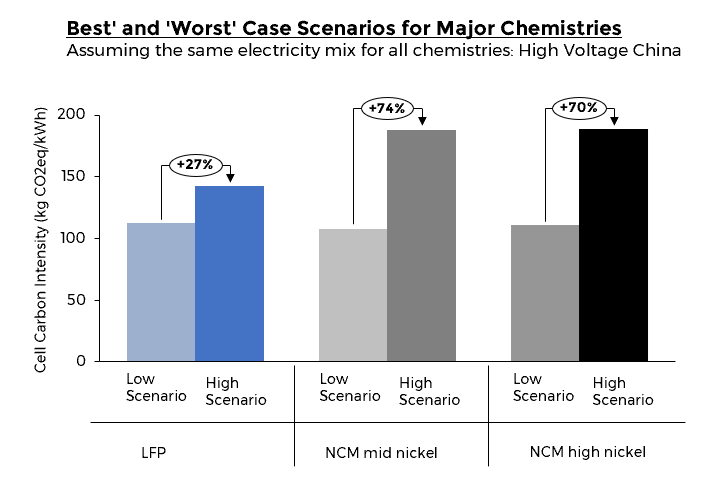
Benchmark has merged its extensive battery datasets, cost models and its sustainability knowledge to create the BEA – a service that is updated continuously.
The interactive dashboard provides stakeholders instant values with customisable inputs including raw material sources and manufacturing locations.
“A path to decarbonising supply requires a deep level of understanding not only of the supply chains of today, but how these will develop in the future,” explained Bruna Grossl, Senior LCA practitioner at Benchmark.
“Being able to run different scenario analysis provides the foundations for more informed and environmentally conscious sourcing decisions”, Grossl added.
Benchmark’s new Battery Emissions Analyser service helps companies across the supply chain to analyse the carbon intensity of different battery chemistries and processing locations.
We will be presenting more analysis in our webinar on Thursday 5 October – see more information and register here.
Our Battery Emissions Analyser is one of a wider range of new Benchmark services for the battery supply chain – including our new Lithium Ion Battery Cell Cost Model, Manganese Sulphate Market Outlook and Phosphoric Acid Market Outlook.
To speak to our experts and learn more about these services – please provide your details here and our team will contact you shortly:
For more information about the service this data draws from, get in touch
Want to read more analytical content?
Create a Free Account
Create a free Intelligence account to access 3 content pieces per month.