More raw material price volatility to come this decade, Benchmark’s Chief Data Officer warns
:format(auto):focal(center))
Downstream consumers will face more battery raw material price volatility this decade, Benchmark’s Caspar Rawles, Chief Data Officer, warned delegates at Benchmark’s Giga Europe 2024 event, being held in Stockholm, Sweden.
While many battery raw material markets are currently in surplus, Benchmark forecasts that by the end of the decade these markets will slip into deficits on the back of long-term demand fundamentals.
“In the next five years, all of these raw material markets, whether it’s lithium, nickel, cobalt, graphite, whatever it may be, are expected to go through a period of deficit,” said Rawles, at the inaugural keynote presentation at Benchmark’s Giga Europe 2024.
Oversupply and slower than expected demand for electric vehicles has sent prices of critical battery materials lower, forcing companies to cut production or slow investments in projects.
“We know this wave of demand is coming and while supplies are adequate now, as we reduce those investments and reduce the future pipeline, we’re creating future periods of volatility,” said Rawles.
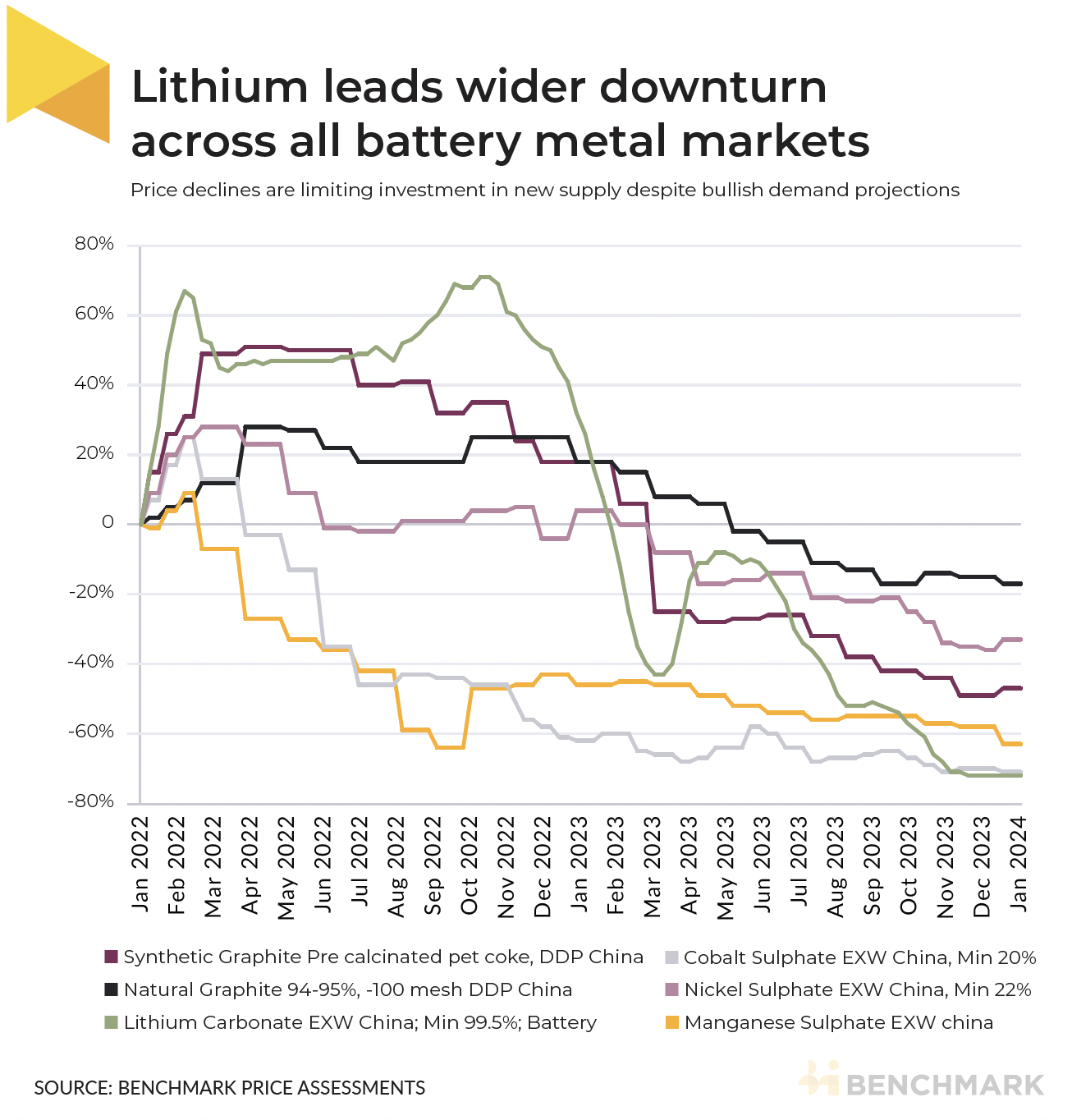
Global weighted average lithium prices have fallen 81% since the beginning of 2023, according to Benchmark’s Lithium Price Assessment.
“One of the trends we see going forward is that the market is going to mature more and more,” said Rawles.
Taking lithium prices as a proxy, Rawles pointed out the current price rout should be put in the context of where they were just a few years ago.
“The market will continue to cycle and we’re just going through a period of lower pricing now,” said Rawles. “If you look all the way back to eight years ago, it’s a whole different world. There were hardly any gigafactories around and it was certainly not a conversation in the mainstream media and mainstream politics.”
Lithium is set to enter an era of deficit from 2029 onwards, according to the Benchmark Lithium Forecast.
The price rout has hit other critical materials as well. Chinese nickel sulphate and cobalt sulphate prices have declined 30% and 23% year-on-year, while flake and synthetic graphite prices are down 36% and 56% respectively since January 2023.
However, falling critical material prices are expected to further lower battery prices and in turn fuel electric vehicle demand.
State push to speed up green transition
As economies across the globe rush to secure critical battery material supplies, the need for increasing government support for ensuring this transition becomes even more important.
While China started preparing a robust battery material supply chain at least over a decade ago, the US with its Inflation Reduction Act and Europe with its soon to come into force Critical Raw Material Act are recent entrants. Given the urgent need to cut global emissions by the end of the decade, more effort is required to speed up the transition.
“The European Critical Raw Materials Act has the potential to increase extraction, recycling and processing within the EU. For example, through streamlined permitting processes. God knows things are not moving fast enough in this union,” said Ebba Busch, Minister for Energy, Business and Industry and Deputy Prime Minister, Government of Sweden.
According to Busch, the state should be a catalyst and accelerator for the green transition, rather than just supplying state aid.
Join us at Giga USA 2024
Discussions on raw material price volatility will continue at Benchmark’s Giga USA 2024 conference behind held June 11-13 at the JW Marriott Washington DC, USA.
This year’s conference will include Benchmark’s inaugural World Lithium Congress. The world’s lithium industry, global governance and finance meet for the world’s biggest and most influential pure play lithium event.
To learn more about the event please provide your details here and we’ll contact you shortly.
For more information about the service this data draws from, get in touch
Want to read more analytical content?
Create a Free Account
Create a free Intelligence account to access 3 content pieces per month.