“Morocco is a sweet spot for the time being.” Q&A with CNGR’s Thorsten Lahrs
:format(auto):focal(center))
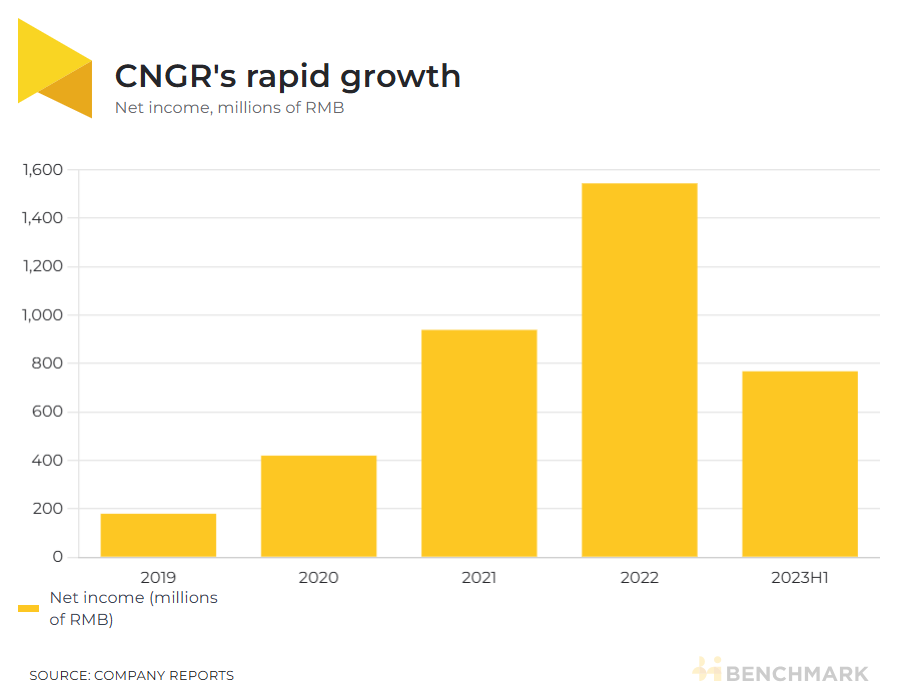
China’s CNGR Advanced Material is the world’s largest producer of precursor cathode active material (pCAM) for lithium ion batteries, and is a key part of the supply chain for some of the largest companies including Tesla and LG Chem.
Listed on the Shenzhen stock exchange with a market capitalisation of $3.9 billion, the company is now looking to supply US and European markets with planned projects in Morocco and Finland.
According to Benchmark, CNGR had a pCAM production capacity of around 300,000 tonnes a year in 2023, and plans to expand this to almost 1 million tonnes by 2030.
Thorsten Lahrs is chief executive of the company’s European operations. He has a long history in the battery industry, having worked for Phostech Lithium in Canada on lithium iron phosphate (LFP) batteries before moving to China to work for Pulead Technology Industry in Beijing.
Benchmark Source sat down with him to learn more.
Could you give us an update on your planned pCAM plant in Finland with Finnish Minerals Group?
We’ve been working on that for four years more or less – since when we discussed with FMG [Finnish Minerals Group] how to establish an entity in Finland and a permitted facility. So Monday next week I expect we’re going to have a published version of our permit.
Why is Finland such an attractive place for this plant?
What Finland did initially years back is they were very early to detect that this will be one of the new waves of industrialization. And they have a framework which is interesting, the basis of it, long term, is that Finland will have the lowest cost CO2-free energy in Europe.
But overall it’s probably the most attractive site to be. So then when you look at what other elements you need, that’s logistics, we found a location east of Helsinki in Hamina … We are directly connected to the sea.
Will Finnish Minerals provide the nickel?
That’s one option. That’s obviously not sufficient. You can probably imagine right now the market situation … I wouldn’t be surprised that many people in the industry today will go a little bit slower.
So will the metal come from your Indonesian plants then?
Yes. In principle we are relying a lot on our own resources. We have to see a little bit for what market actually we’re going to do it. Finland typically was intended for Europe. As of today, Europe is a little bit difficult to export to the US as there’s no FTA. And Morocco is.
We will see. I mean, we now have a lot of impact and regulatory forces which are changing all the time. So when you take the IRA context, we have elections in November and then we have Donald Trump, who has his own opinion on EVs and his own opinion on China … I think everyone is sort of lying back and saying, hmm, what does it mean.
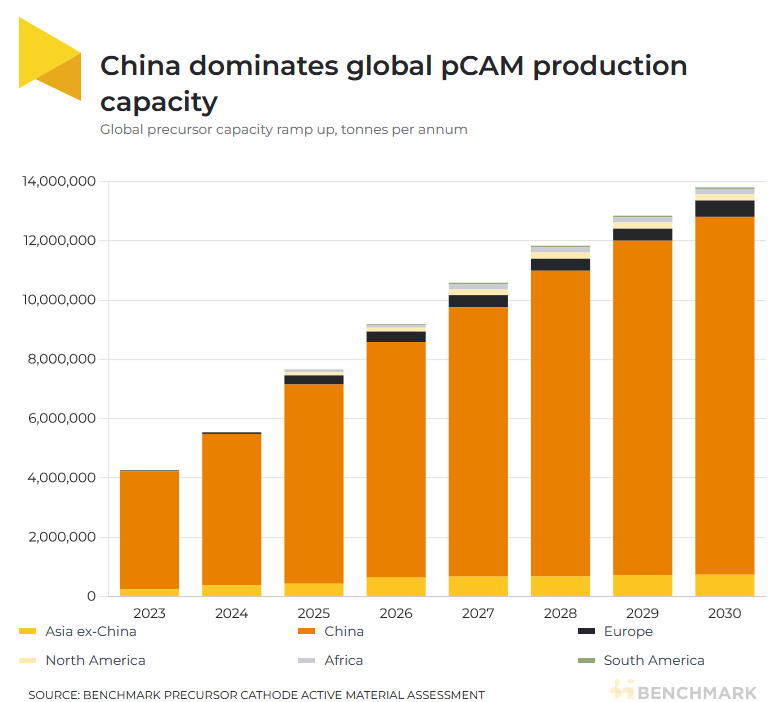
Can pCAM production outside of China be competitive?
I mean, in the long run I think we all agree, even on the Chinese side, it’s probably not very intelligent to have all your eggs in one nest. So having 90% come out of a certain region, however you call it, really is not something which is probably sustainable. But how you shift that away in a context where you have a price war in China and therefore any new facilities are at the top price point is not an easy answer.
So do you think the targets in the EU Critical Raw Materials Act are too ambitious?
At the moment I think it’s not too ambitious, but any number without any further regulations or detail on how to execute that will maybe lead to nothing. It’s an ambitious statement, but at this point of time, it will stay at that point.
So moving on to talk about Morocco, why did you choose the country for battery materials production?
Morocco is a sweet spot for the time being, because it has a FTA [Free Trade Agreement] with the US, and with Europe. It is obviously a little bit less expensive going to Morocco, it is faster going to Morocco.
And in the context of the IRA speed is relevant. Because it’s kicking in next year. You will not be able to do that in North America, or in Europe, simply because the permitting process would not allow you to be that fast. [In Morocco] certain work we can start already. And then the main work will start quite soon.
Have you agreed with Morocco’s OCP Group to supply phosphate for the LFP materials?
In principle that’s the case. And we [discussions] are still ongoing. So we have not yet finalised how to handle the LFP ramp up. The LFP discussion is intensifying in Europe. Much more during the last year. But with such low raw material prices on nickel, it’s already difficult to bring nickel chemistry out of China to Europe or anywhere else. To stay competitive. Actually, you’re not. And for LFP I would say in relative terms it’s even more complicated.
And in terms of the Inflation Reduction Act how does it work out with the Foreign Entity of Concern provisions? Will you adjust the equity ownership? Is there a way around it?
It’s a question which interpretation you follow. I mean, based on what we hear … the actual interpretation would let us think that we are not impacted.
We are privately owned, and none of our officials is connected to the Chinese government.
You are working on a new process for producing nickel matte using an oxygen-enriched side-blown furnace, which you say is lower emissions, could you give us some details on that?
We are a little bit delayed in terms of the start of production, because it’s a new technology so we had to fix some issues. Now it’s running relatively stable. We are just measuring, so we will have validated data, hopefully this quarter. What I’m seeing right now is it’s significantly lower [emissions] compared to RKEF.
And it has a big advantage in that the tailings are not there. And the tailings sit there for how many years? … Some big players are starting to rethink that a little bit. Should you first discuss the long term liabilities and then you discuss CO2?
Are automakers willing to pay a green premium for nickel?
I think we are all struggling with how to price it.
For more information about the service this data draws from, get in touch
Want to read more analytical content?
Create a Free Account
Create a free Intelligence account to access 3 content pieces per month.