North America’s recycling capacity set to overtake Europe this year
:format(auto):focal(center))
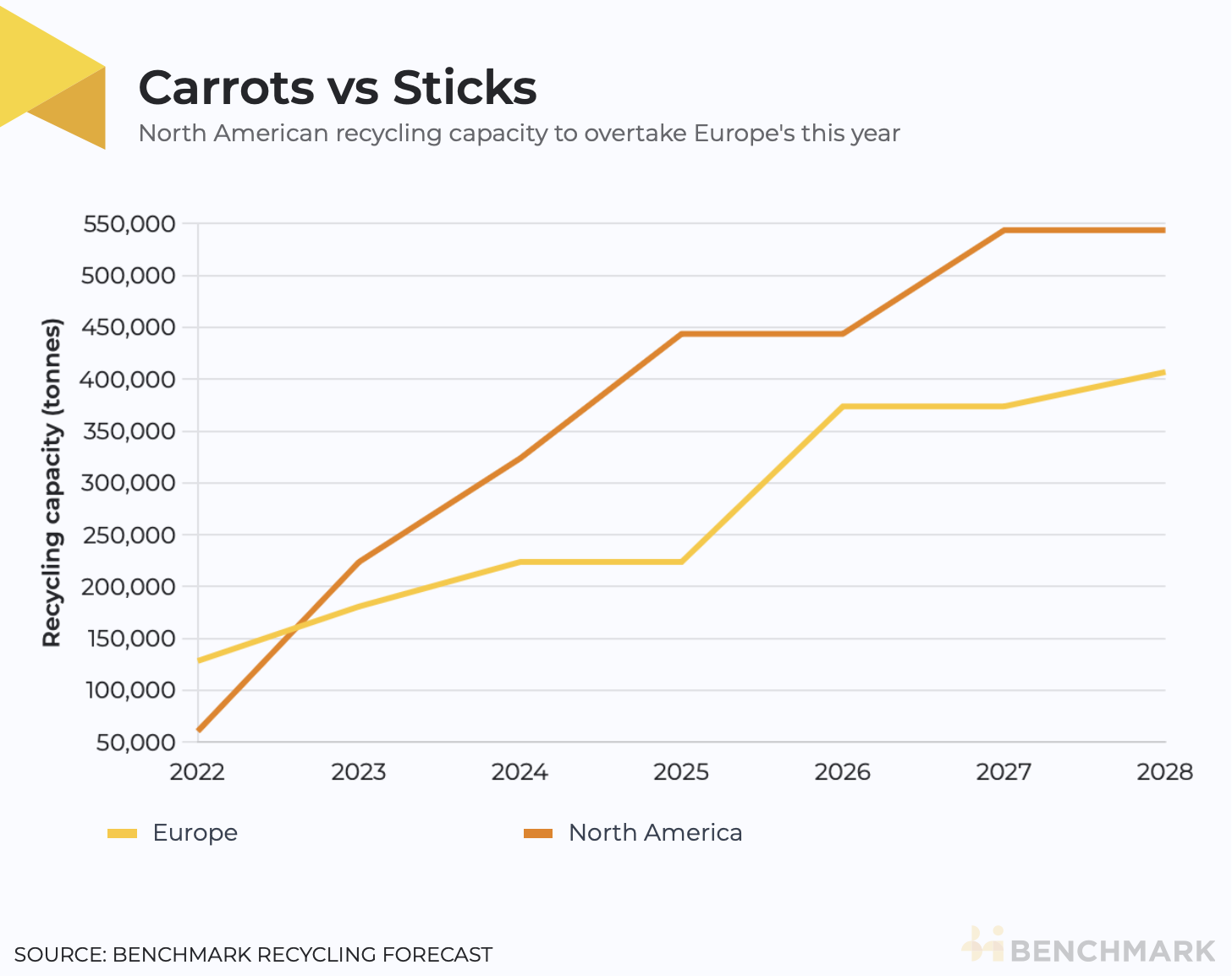
North America’s battery recycling capacity is expected to overtake Europe this year, as President Joe Biden’t Inflation Reduction Act spurs a wave of investment in the country.
Benchmark’s Recycling Forecast shows that North American recycling capacity is set to increase 270% compared to last year. Europe, however, is only expected to grow 40%, allowing the region to fall behind to North America.
The divergence highlights the impact of President Joe Biden’s IRA, which Europe has said risks distorting global markets via subsidies. The landmark climate deal includes minerals recycled in North America as an eligible source for automakers looking to receive electric vehicle tax credits.
Europe is hoping that new legislation mandating how much material in a new battery comes from recycled sources and how efficiently recyclers operate will spur investment in the region.
“[Legislation] is going to be a major driver of where the where the recycling infrastructure is put in,” Roger Lin, vice president of Ascend Elements, a US-based battery recycler, told Benchmark.
The US’s carrot
The IRA awards up to $7,500 in tax credits against the purchase of an electric vehicle. Part of the eligibility criteria for these credits is to have 80% of the value of the critical raw materials contained within the battery sourced from the US or a Free Trade Agreement country or to have been recycled in North America by 2027.
Further incentivising the development of recycling capacity in the US are production tax credits towards the production of cathode and anode active materials or critical minerals such as lithium carbonate or hydroxide. Section 45X of the IRA, for example, gives a tax credit equal to 10% of the cost of the production of such material.
The IRA is widely acknowledged to be a direct response to China’s ever-increasing stronghold on much of the lithium ion battery supply chain from the production of high-purity chemicals through to cathode, anode and cell production.
“The United States has really focused on creating market demand and then driving domestic content. Supply chain security issues are driving that kind of legislation.” Lin said. “Recyclers in the US are acting as a strategic minerals, strategic elements concentration point. Those materials that end up being sold into the US through batteries will end up staying there.”
Additionally, as part of the Bipartisan Infrastructure Law, the Department of Energy has given out several billion dollars in grants across the supply chain including, Ascend Elements which received a $3.16 million grant to produce pre-cathode active materials from used batteries.
“The US with the IRA and the BIL that was passed recently are leaping forward very very quickly,” Lin said. “There is probably more of a shift in lithium ion battery manufacturing and ancillary industries towards the US because of that.”
Europe’s stick
The European Union’s proposed battery recycling legislation to replace the 2006 Batteries Directive was approved by the Council in January this year and now needs to be formally approved by the Parliament before coming into force.
The proposed legislation sets out mandates for the minimum amount of recycled minerals contained lithium ion batteries sold in the EU. These will start at 6% for lithium and nickel and 16% for cobalt in 2031, if the legislation is passed this year.
The targets will rise to 12% for lithium, 15% for nickel and 26% for cobalt in 2036 (or 13 years after the legislation is passed).
It also sets out targets for the recovery efficiency of the recycling processes. By 2031, recyclers will need to recover at least 80% of the lithium in the batteries they recycle and 95% of the contained cobalt and nickel.
Lin said Ascend Elements would consider building facilities in Europe and the UK, but would need further understanding on exactly how these mandates would be enforced.
“Once we understand what the implications are for, you know, not able not being able to meet those recycled content requirements over time, it’ll help us gauge what the market reaction would be,” Lin said. “It’s not as certain as an incentive or a credit would be.”
“It has more of an ESG or sustainability goal to it [than the IRA],” Lin said, going on to say that the EU approach is more of a penalty whereas the IRA is an incentive.
“I think they can both be successful,” he said. “In my opinion, I think the [IRA] is probably the more powerful because it’s more economically driven.”
Battery Gigafactories Europe & USA 2023
For more information about the service this data draws from, get in touch
Want to read more analytical content?
Create a Free Account
Create a free Intelligence account to access 3 content pieces per month.