One year on, Biden’s IRA has changed the battery landscape
:format(auto):focal(center))
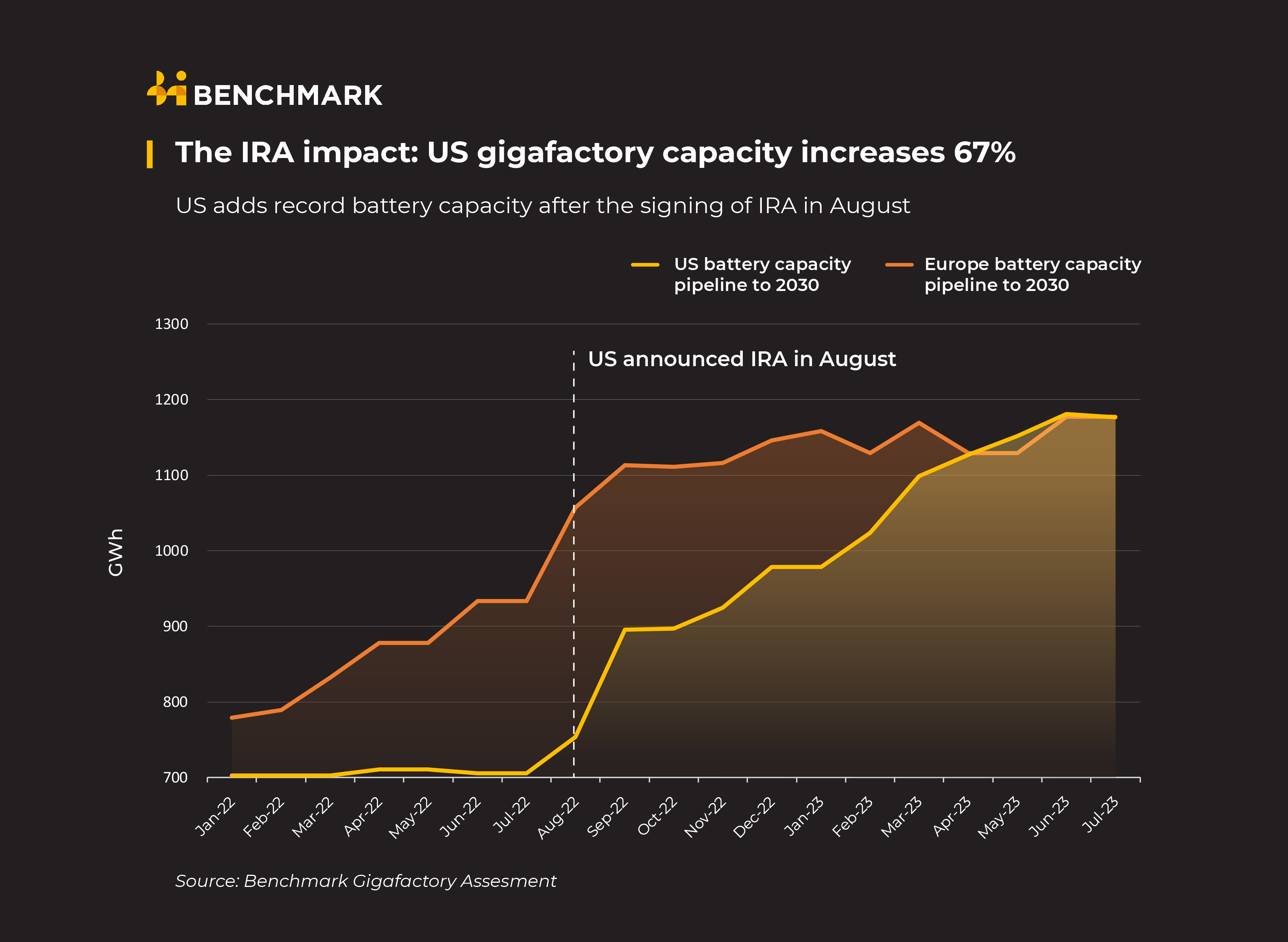
President Joe Biden’s Inflation Reduction Act has changed the battery landscape in the US, leading to a gigafactory building boom that has increased forecast battery capacity by two thirds, according to Benchmark.
The landmark climate bill’s tax credits for battery manufacturing has led to the announcement of 14 new planned battery gigafactories since last July, according to Benchmark’s Gigafactory Assessment. That pushed the US from having less battery capacity in the pipeline to Europe, to being roughly equal to Europe’s planned buildout.
“The IRA has been game changing legislation,” Manish Dua, an analyst with Benchmark, said. “Massive outlay of subsidies and tax credits has boosted private sector participation across the whole cleantech space.”
Signed into law by President Biden on August 16, the IRA has led to over $110 billion of capital investments announced for clean energy manufacturing projects, including over $70 billion towards EV and battery supply chains across different parts of the United States.
“Powered by the IRA, the President’s agenda has helped drive a massive boom that is touching every corner of the country,” Janet Yellen, the US Treasury Secretary, said this week.
US gigafactory capacity in the pipeline out to 2030 has risen from 706 gigawatt hours in July 2022, just before the IRA was signed into law, to over 1.2 terawatt hours as of last month, according to Benchmark.
In addition, since the IRA, the North American capacity for cheaper lithium iron phosphate (LFP) cell production is expected to grow significantly across the decade, with 155.9 GWh of pipeline capacity to 2030, according to the Benchmark Gigafactory Assessment.
The power of tax credits
The IRA provides tax credits for US based battery production equal to $35 a kilowatt hour for production of battery cells and an additional $10/kWh for battery modules.
It also provides 10% credit on costs for mining critical minerals and producing battery materials such as cathodes and anodes.
In addition, the IRA stimulates demand for electric vehicles by providing up to $7,500 in tax credits for EV purchases, if automakers meet certain critical mineral conditions and manufacture a certain percentage of components in North America.
More than 320,000 electric vehicles were sold in the US in the first quarter of 2023, 60% more than the same period in 2022, according to the International Energy Agency. Sales of electric vehicles, including plug-in hybrids, have risen to 25% of new vehicle sales in California.
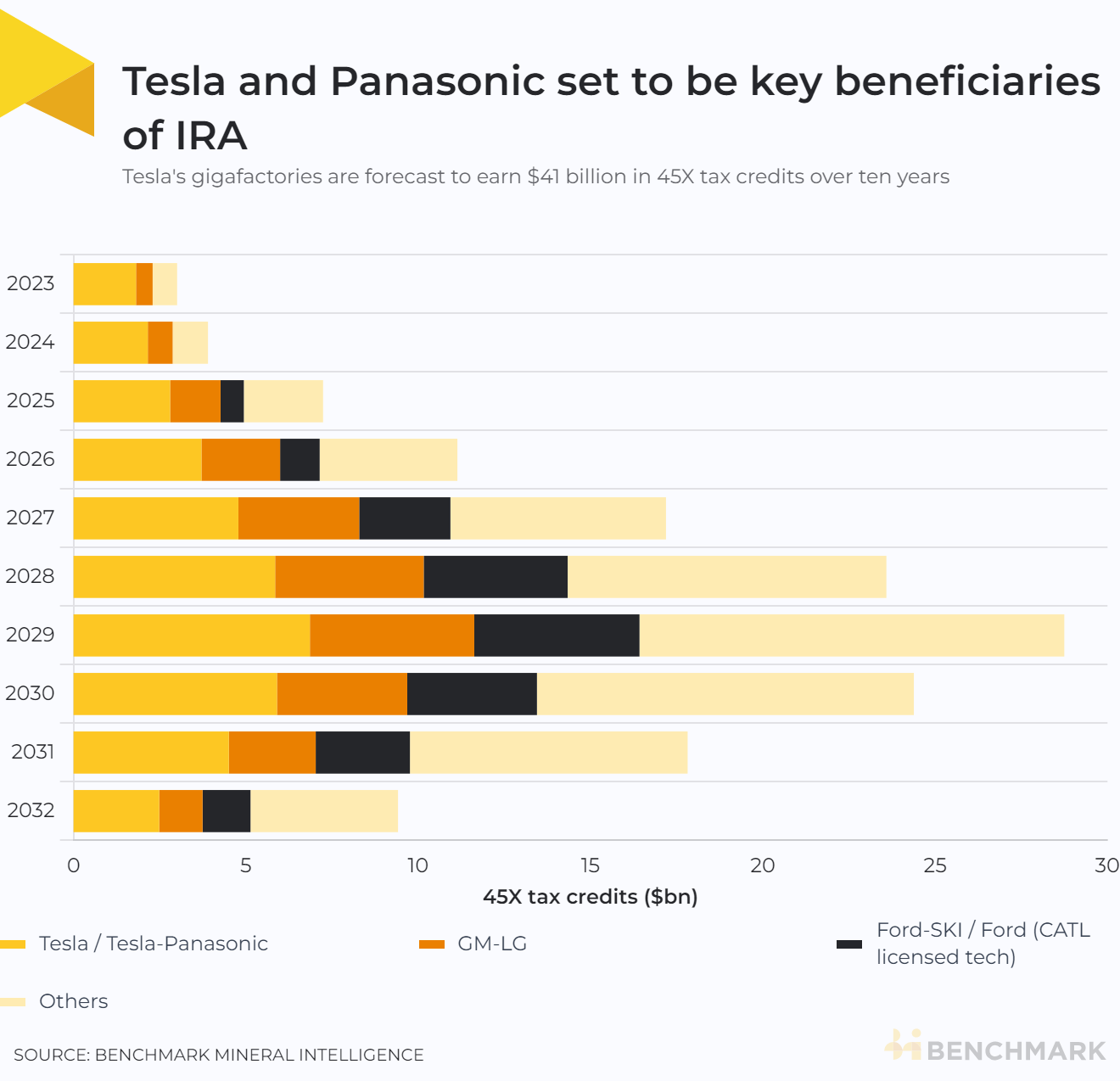
Benchmark analysis shows that automakers and battery producers could get over $140 billion in benefits from the battery production tax credits over the next decade.
Tesla and its battery partner Panasonic are likely to be the main beneficiaries of the tax credits, with Tesla and Panasonic in line to receive $41 billion in tax credits by the end of 2032, according to Benchmark analysis.
Tesla has said it expects the benefits from the IRA manufacturing incentives to be around $150 million to $250 million per quarter, including a 50-50 sharing of credits for qualified cells with Panasonic.
In November, Panasonic broke ground on a new battery factory in Kansas, which it says will produce 30 GWh of batteries a year for EV manufacturers in the US.
The company said it expects operating profit at Panasonic Energy to rise fourfold to 133 billion yen ($916 million) this year, thanks in part to US tax credits as well as increased battery sales.
Escalating costs
Because most of the IRA’s subsidies come in the form of uncapped tax credits the final cost of the IRA has yet to be determined, and could eventually rise above $1 trillion, according to various estimates.
Benchmark forecasts that just the total estimated cost for the Advanced Manufacturing Production Tax Credits could reach $150 billion by 2032.
If the US EV adoption targets were to be fulfilled, by 2031 about a total of 59 million EVs would be eligible for at least half of the $7,500 tax credits on offer. This would translate into $220 billion of cumulative funding by 2031.
Investment in cathodes and anodes
The IRA has not only accelerated a buildout of battery factories, but also investment in battery cathode and anode plants.
This month chemicals company ICL broke ground on a $400 million plant in St. Louis which will produce 30,000 tonnes a year of lithium iron phosphate (LFP) cathodes.
And in April, startup 6K Energy announced plans to develop a 13,000 tpa capacity cathode manufacturing facility, in Jackson, Tennessee.
North America now has around 915,000 tonnes per year of cathode production capacity in the pipeline, compared with Europe’s 617,500 tpa, according to Benchmark’s Cathode Assessment.
Investment has also accelerated in FTA countries, as critical minerals and battery materials from these countries are eligible for tax credits in the US.
Exports of cathode from South Korea rose by 178% in the first seven months of this year, compared to a year earlier, according to the Korea International Trade Association (KITA).
Still, in anodes, there needs to be a lot more investment. North America is still only set to account for 2% of global anode supply by the end of the decade, according to the Benchmark Anode Forecast.
Benchmark’s uniquely comprehensive coverage of midstream markets brings transparency to a particularly opaque part of the lithium ion battery value chain.
This analysis draws from Benchmark’s Gigafactory Assessment, Cathode Price Assessment service, Anode Forecast service and bespoke consultancy capabilities.
To learn more about these services, please leave your contact details below and our team of experts will be in touch.
For more information about the service this data draws from, get in touch
Want to read more analytical content?
Create a Free Account
Create a free Intelligence account to access 3 content pieces per month.