OPINION: What will be the eventual cost of the US Inflation Reduction Act?
:format(auto):focal(center))
The more we learn about the scope and quantum of the Inflation Reduction Act, the higher the dollar bill goes up.
But is there a limit on how much money is the US capable of spending? What if the Congressional Budget Office (CBO) estimates made at the time of the IRA’s approval were to become hard spending ceilings?
What is clear is that the groundbreaking regulation has re-directed the West’s attention to the US as the land of investment and opportunity in the lithium ion value chain.
Benchmark data shows that announced gigafactories in the US have increased by nearly 60% since the IRA was passed with total capacity pipeline to 2031 at 1,190 gigawatt hours.
Several European and South Korean battery groups such as Freyr, LGES and SK On are accelerating investments in North America that were probably distant “growth options” before the IRA was approved. Upstream there is a flurry of activity from free trade agreement-based companies to take full advantage of the benefits.
How much will be needed
We have recently run an analysis on how much funding will be needed if everyone and every project along the value chain that qualifies for funding was to apply for it. To do this we use Benchmark’s proprietary forecasts on production, operating costs and capital expenditure along the value chain that would be located in the US.
The chart below depicts the estimated demand for funds under the Advanced Manufacturing Production Credit, known as Section 13502, which are meant to be a contribution on eligible operating costs for US-based facilities that produce batteries and its core components upstream (critical minerals, cathode and anode).
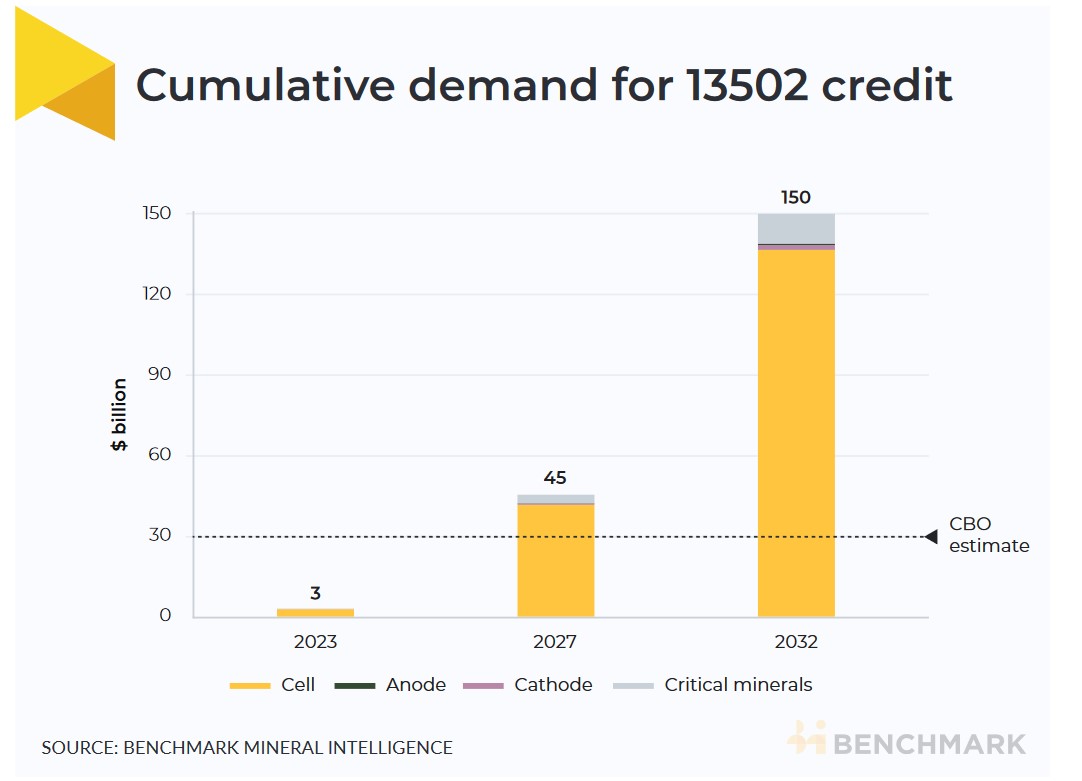
The total estimated cost for this provision could reach $150 billion by 2032, which is almost a fifth of the total IRA cost estimate, and, five times higher than the CBO estimated to be the demand for this benefit at the time of its approval.
In other words, the CBO estimate would only cover a fraction of the 1,910 GWh that could be built by 2031. Demand for funding is also expected to continue to grow as more gigafactories are announced.
This issue is repeated across the IRA provisions, including for one of the most coveted benefits: the demand-side clean vehicle credit (CVC).
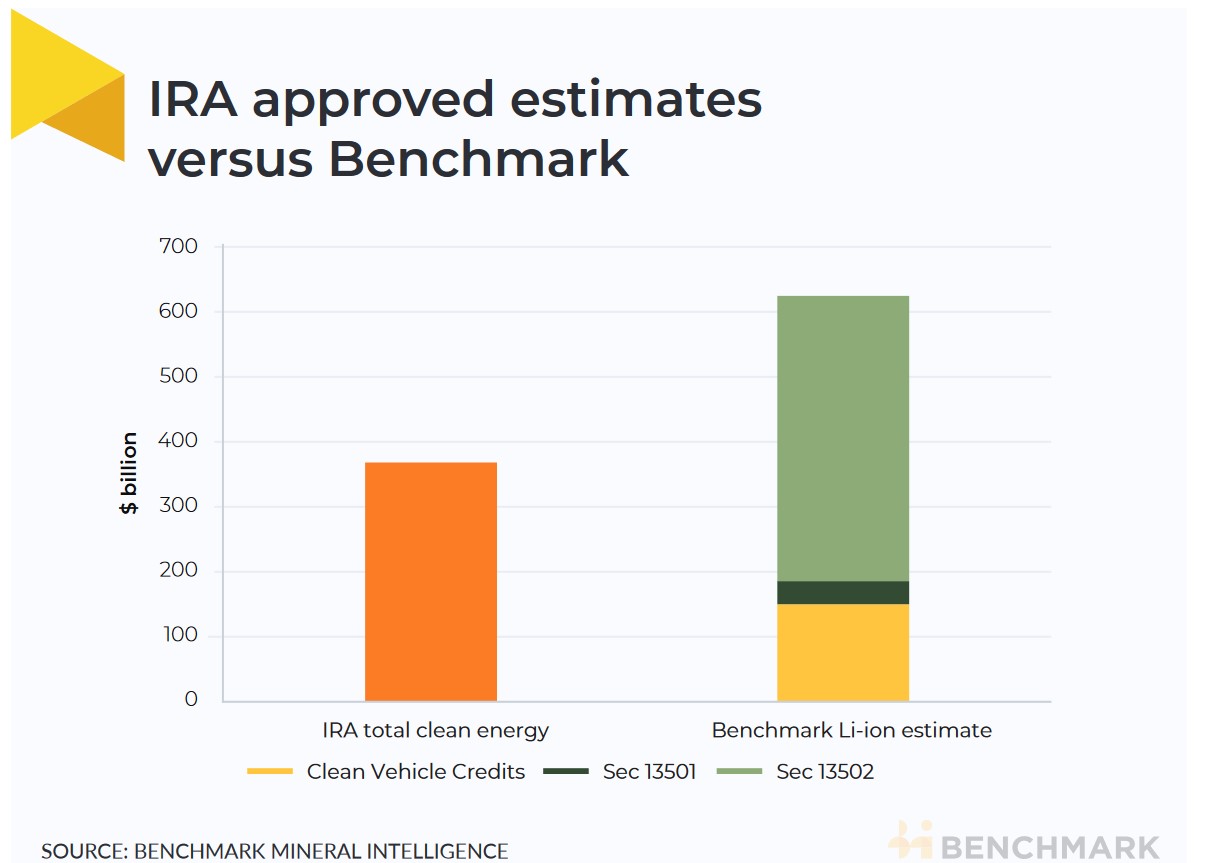
Benchmark’s analysis indicates that if the US EV adoption targets were to be fulfilled, by 2031 about a total of 59 million EVs would be eligible for at least half of the $7,500 tax credits on offer. This would translate into $220 billion of cumulative funding by 2031.
The CBO estimate, at a meagre $7.5 billion, would be enough for only 380,000 EVs in total, each with a credit of $3,750, during the same period.
Benchmark estimates for the main provisions – and only the ones related to lithium ion value chain, are almost twice as much as the IRA total clean energy estimate at the time of approval.
And while we believe that lithium ion applications are likely to have a dominant role in the applications for funding, the IRA is clear that other non-lithium ion technologies such as solar, hydrogen, carbon storage and many more, are also eligible, and will therefore compete, for the same funding pool.
The reality of uncapped tax credits
Unfortunately, trying to answer the question on how much is actually going to be available is an impossibility.
Most provisions relevant to the lithium ion value chain do not have a ceiling which leads supporters of the legislation to say “as much as is needed, there is no limit.” In practice though, we all know that it cannot be a bottomless pit with no fiscal implications.
Trying to estimate a middle ground figure requires having a view on what the US Congress will do over the next 10 years – and the recent discussion on debt ceiling have made clear that the two main political parties remain quite far apart on fiscal matters.
The only thing that is clear at this stage is that the level of actual funds available will be uncertain. Investors and participants looking to secure IRA funds will need to factor this uncertainty in their business plans with proper risk assessment and risk management practices.
Some emerging themes and trade-offs in this area include:
· Speed is essential, but if companies try too hard to get every penny from the IRA they may be too late to the party.
· Accelerating development investment will increase the chances of being on time, but it will also increase the dollar value of investment at risk
· No-one can accurately predict what the US Congress will do so developing IRA scenarios and implementing (or enhancing) a portfolio-driven investment approach may be essential.
Benchmark’s Consultancy division advises market participants across the supply chain on a range of strategic development and investment areas as global policies and regulations evolve.Please provide your details below to speak to our global team of experts on the opportunities and challenges facing your business.
For more information about the service this data draws from, get in touch
Want to read more analytical content?
Create a Free Account
Create a free Intelligence account to access 3 content pieces per month.