Tesla charts a battery-powered future: key takeaways from 2023 Investor Day
:format(auto):focal(center))
Tesla’s CEO Elon Musk told investors the world needed 240 terawatt hours (TWh) of batteries and $10 trillion of investment to transition to a sustainable energy economy, but failed to detail how the automaker would scale-up its own production and supply chain.
Musk revealed at the company’s Investor Day that Tesla would build a plant in Mexico, cut rare earths from its vehicles and build a lithium refinery in Texas this year, but offered few details on a new mass market vehicle.
While Musk disappointed expectations for a more detailed “Master Plan”, the move to refine lithium and eliminate rare earths highlight its intention to control every aspect of its supply chain and lower costs.
Musk reiterated the company’s plans to sell 20 million vehicles by 2030, a feat that would require 1.2 million tonnes of lithium chemicals – more than the entire market last year. It also wants to produce 1 TWh a year of energy storage batteries.
“Tesla’s Investor Day lacked in many ways: major headlines, supply chain detail, timelines,” Simon Moores, chief executive of Benchmark, said. “What it did show is how far Tesla has come in every arena of developing an EV which I think will be an eye opener to investors and competitors alike.”
Benchmark looks at each of the announcements from the three-hour event:
Lack of a new lower priced Tesla
The lack of a ‘next generation’ EV was the stand our disappointment among an investor day designed to introduce all departments and R&D happenings.
While a number of references to a new sub $30,000 EV, or what Wall Street has referred to as the Model 2, there was no announcement as to when we can expect the Model 3’s true successor.
It felt like the Mexico Gigafactory and the introduction to costs reductions in many areas was a teaser to the final reveal that never happened.
Any new sub-$30k offering will have to wait for a number of macro economic factors to subside – especially battery cell prices, which remain high due to battery raw material prices.
The low end EV would need to be LFP, would need to travel at least 200 miles and would probably have to be built in a lower cost jurisdiction (Mexico, China, a new gigafactory in South East Asia?).
To push the selling price of any Tesla below the $30k mark, the company would also need most of its vertical integration announcements to succeed and imbed into the company workflow.
On that the launch party can wait.
FirstLithium Refinery
Tesla said it would start production at its 50 GWh a year lithium refinery in Corpus Christi, Texas, this year, marking its first foray into chemical engineering.
It would also start production at one line of its planned 60 GWh a year cathode facility at the Texas gigafactory next quarter.
The lithium refinery output would translate into around 40,000 tonnes a year of LCE, according to Benchmark.
Reaching a target of 20 million EVs by 2030 would require around 1.2m tonnes of lithium chemicals and the industry last year was less than 1 million tonnes in size.
Tesla said the plant will use a “direct soda ash leach” process to convert spodumene without the need for acid roasting. Benchmark understands that Tesla intends to use a hydro-metallurgical process which eliminates the need for sulphuric acid.
The plan is “a big step into the unknown for Tesla – a shift from ‘physical’ engineering that has come to define the business culture to chemical engineering,” according to Moores.
“No matter how simple Tesla may make these challenges sound, scaling speciality chemical supply – especially lithium – is probably the hardest thing to do in the battery supply chain,” he said.
However, the most important factor to Tesla being in the lithium refining business could be the sway it gives it in contract negotiations for future volumes of lithium from external suppliers, Moores added.
Betting big on LFP
Musk doubled down on Tesla’s bet on lithium iron phosphate (LFP) batteries, saying they could be used to electrifty almost all forms transport.
“You only need nickel for aircrafts or boats or long range cars or trucks. The vast majority of heavy lifting for electrification would be done by iron based chemistry,” Musk said.
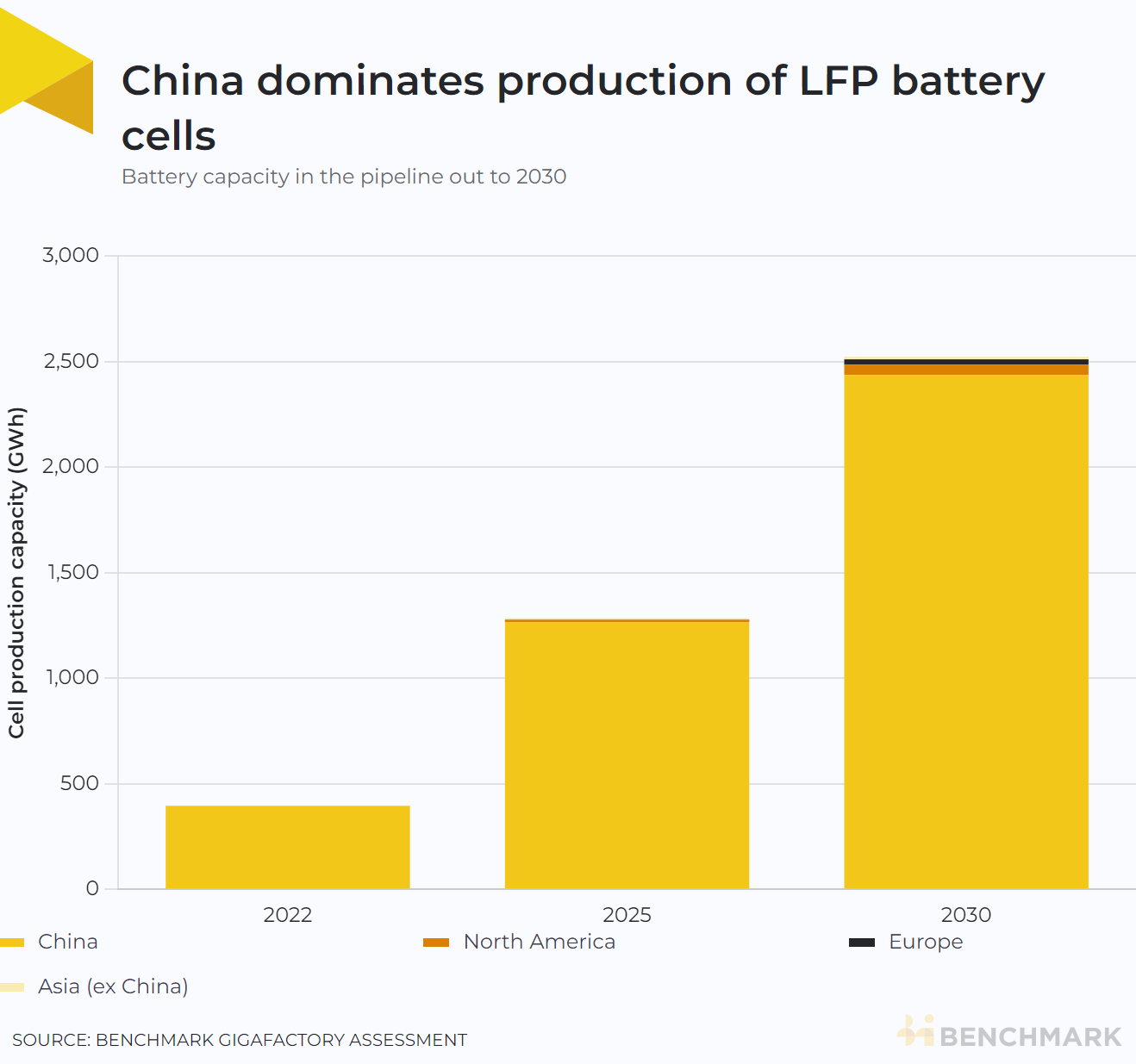
LFP batteries are currently up to 30% cheaper than the high nickel NCM and NCA cells also used by Tesla as they don’t require nickel and cobalt, according to Benchmark’s Lithium Ion Battery Cell Price Assessment.
But their production is concentrated in China, creating a geopolitical risk for automakers.
There is also the question of whether customers will accept passenger vehicles with a mid-200 mile range.
A Mexican gigafactory
Musk also revealed plans to set up a gigafactory in Mexico but did not provide details, highlighting how revealing new plants is not what it was a few years ago.
Benchmark is currently tracking 372 gigafactories globally.
“We are going to build a gigafactory in Mexico. Gigafactory Mexico will supplement the output from other factories. It will build the next generation vehicle which we will do in our other plants as well,” said Musk.
Eliminating Rare Earths
Perhaps of biggest interest for raw materials was Tesla’s announcement that it would eliminate rare earths from its electric motors.
The move is back to the future for Tesla, which was quite vocal about the fact it did not need rare earths in Model S and X before it changed tack for the Model 3.
The market implications remain to be seen, however, and will depend principally on the ability of Tesla’s new fleet of EVs to compete with major competitors on vehicle efficiency and cost, according to Benchmark.
“Eliminating rare earths from new future Tesla EVs is important for scale,” Moores said. “Rare earths is the most extreme of all critical minerals with over 85% mined and refined in China.”
Master Plan 3
Musks’ forecast of total installed battery storage of 240 TWh would translate into a lithium ion battery production of 16 TWh a year, sixteen times today’s industry in terms of output in 2023, according to Benchmark.
The global battery production is set to surpass one terawatt-hour for the first time in 2023, and reach 4 TWh in 2030, according to the Benchmark Lithium Ion Battery database.
“Considering the battery cell industry has scaled ten times in seven years, this is a achievable goal albeit the focus moves to building the mining and refining infrastructure to support this,” Moores said. “It will take a short generation (15-20 years) to get this right.”
Request a Benchmark Source trial
This is a Benchmark Source article.
To access more insights, data visualisations, analysis, and opinion on the lithium ion battery supply chain request a Benchmark Source trial here or contact us with the form below:
For more information about the service this data draws from, get in touch
Want to read more analytical content?
Create a Free Account
Create a free Intelligence account to access 3 content pieces per month.