The rise of alternative pricing mechanisms in the nickel sulphate market
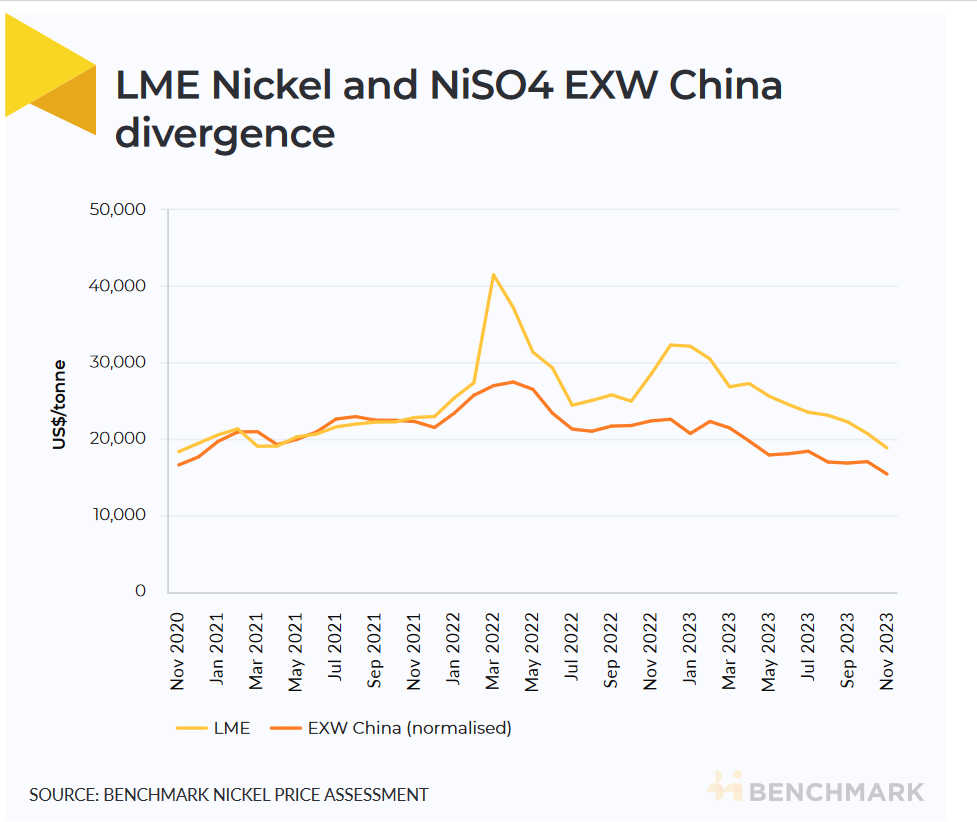
In the year leading up to a short squeeze in nickel on the London Metal Exchange (LME) in March 2022, Benchmark’s nickel sulphate, EXW China price, closely tracked the LME Class I nickel price with a statistical discrepancy of just 4% on a monthly basis.
However, following those events, a demonstrable bifurcation has occurred, with that statistical discrepancy increasing by more than five times to 21%.
That reflects an increased use of alternative pricing mechanisms.
With stainless steel continuing to make up more than 68% of global nickel demand, according to Benchmark’s Nickel Forecast, the LME price remains a reflection of the stainless steel market rather than the supply-demand dynamics of the nickel chemical to lithium ion battery supply chain. Therefore, any changes in the dynamics of this industrial world will have significant implications for the price of nickel battery materials, under conventional sulphate pricing mechanisms.
For example, in a scenario where a major economy introduces a stimulus package targeted towards the construction or engineering industries, this would be bullish for the stainless steel industry and therefore inadvertently increase nickel chemical prices for the battery industry should it be priced on LME exchange prices. This would be as true during a period of weak battery demand as it would be during a period of firm demand for nickel battery chemicals.
Whilst such a dynamic is not a strategic concern for many nickel miners, it has become an ever greater concern for downstream market participants, keen to minimise basis risk in their procurement and hedging strategies.
Benchmark data further shows that nickel demand from the lithium-ion battery industry is set to grow as a proportion of total nickel demand from 16.5% to more than 34.1% in 2030.
The importance of Chinese sulphate in the CIF Asia market
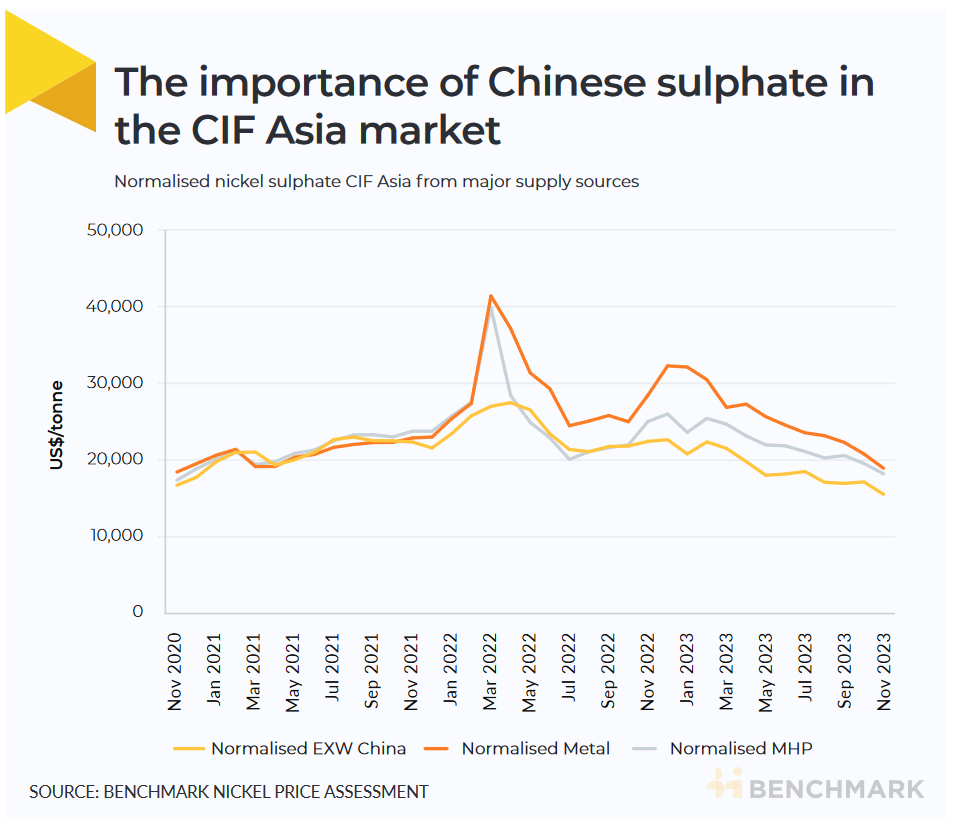
According to Benchmark’s Cathode Forecast, an estimated 71% of global cathode capacity in 2023 is based in China alone. This goes some way towards explaining the ease with which the domestic Chinese nickel sulphate price has bifurcated from the LME nickel futures price.
Furthermore, nickel sulphate produced in China makes up more than two thirds of the nickel sulphate volumes purchased by South Korean and Japanese buyers. For this reason, Asian market participants outside of China have reported to Benchmark that some of their new nickel sulphate contracts feature mechanisms that rely on pricing based on the mixed hydroxide precipitate (MHP) to nickel sulphate supply chain rather than the historic reference to LME.
MHP to play a growing role in Asian sulphate pricing
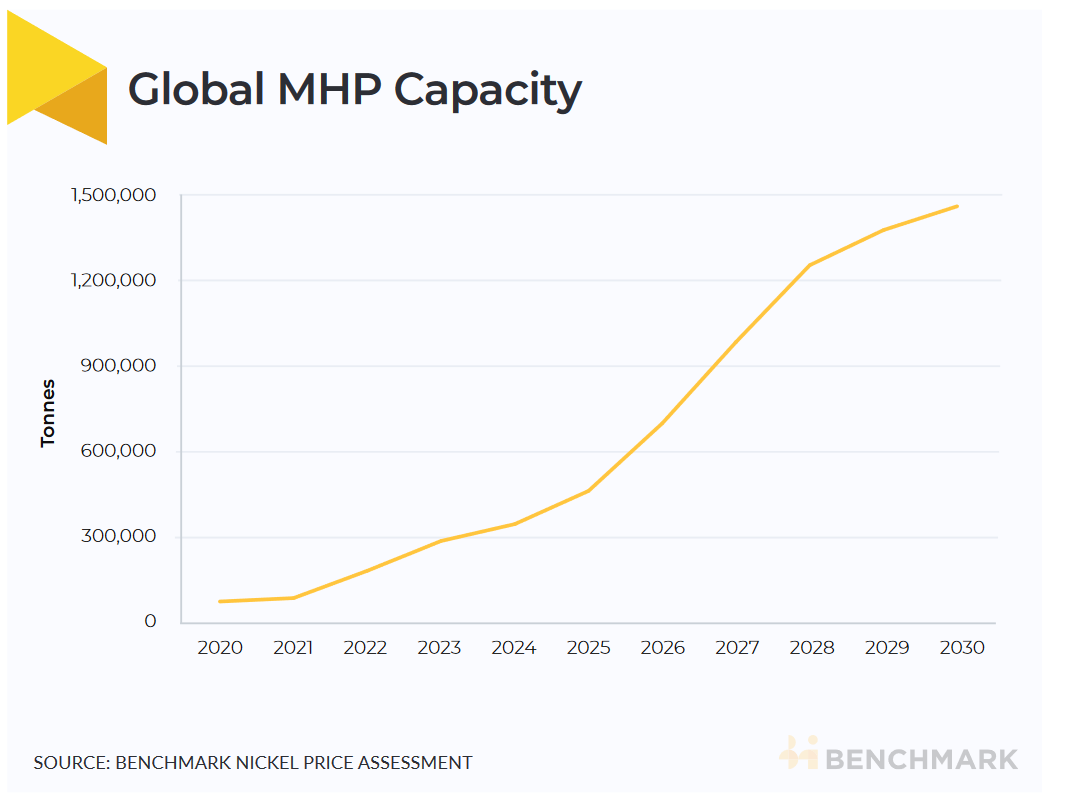
In both Indonesia and the Philippines, large investments into MHP production via high pressure acid leaching (HPAL) continue to be made, resulting in significant MHP capacity increases in the region. This rapidly growing MHP capacity will result in an increase low cost feed for nickel sulphate producers, affecting prices in both China and the wider Asian region.
This rapidly growing MHP capacity will result in an increase in sulphate supply, affecting prices in both China and Asia.
Benchmark has also seen a greater diversity of MHP pricing mechanisms in recent months, rather than the conventional payable to the LME approach. It is therefore vital to market participants that whilst more mature nickel sulphate pricing mechanisms consider the significance of Chinese EXW product as a source of supply, they must also consider the economics of MHP conversion to more fully represent the CIF Asia and lithium ion battery market.
Metal to remain an important element of nickel sulphate pricing
Since the South Korean and Indonesian governments met in July 2023 to discuss cooperating in strengthening each nation’s battery manufacturing sector, there has been a clear ambition from South Korean companies to invest in an Indonesia-South Korea-US cathode supply chain.
With companies such as LG Chem and SK Innovation revealing plans for new pCAM production facilities in South Korea using Indonesian nickel, the Indonesia-South Korea trade route will likely see much larger volumes.
Whilst South Korean nickel chemical buyers in particular have expressed unease with the conventional LME premium pricing mechanism, it is also clear that any new price mechanism cannot represent a complete divorce from the Class I metal prices.
Although growth in Class II capacity outpaces Class I, the technology gap between the two is closing. In October, the LME announced that Chinese battery materials major, CNGR, had applied for listing on the exchange, hoping to sell the Class I nickel it produces from Indonesian nickel matte. Furthermore, dissolving metal to produce nickel sulphate is a well-established conversion method, especially in Japan.
Consequently, it is important that the evolution of CIF Asia nickel sulphate pricing maintains a valid connection to nickel metal values, which is why this remains one of the three critical supply routes behind Benchmark’s new normalised nickel sulphate CIF Asia (100% Ni contained)price.
Benchmark’s new Nickel Sulphate, CIF Asia, normalised price is provided in our Nickel Price Assessment.
Our Nickel Price Assessment provides independent price assessments and analysis for nickel sulphate, nickel MHP and normalisation factors.
To learn more and request a sample price report, please provide your details here and our experts will contact you shortly.
For more information about the service this data draws from, get in touch
Want to read more analytical content?
Create a Free Account
Create a free Intelligence account to access 3 content pieces per month.