US battery production could beat China on cost due to IRA tax credits
:format(auto):focal(center))
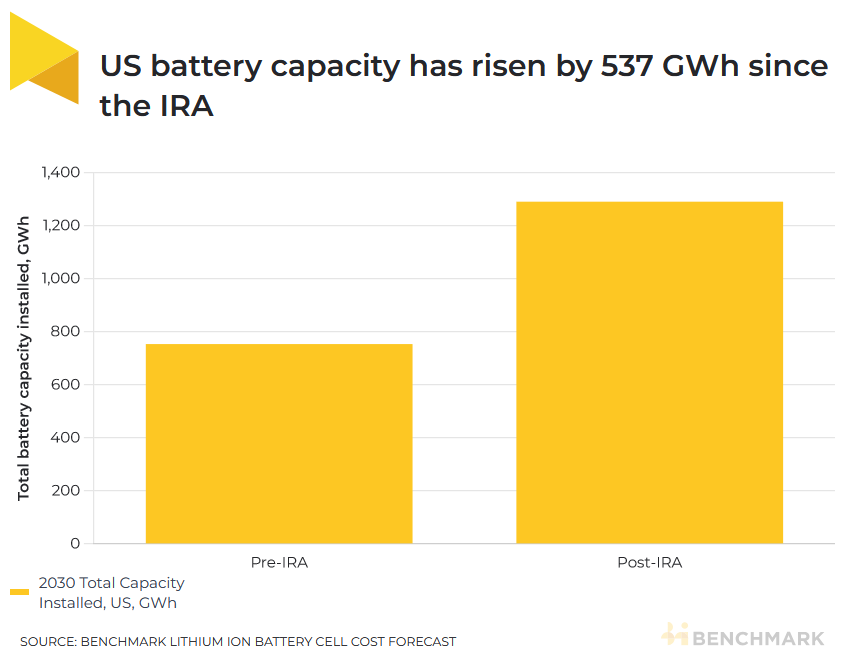
US battery production could potentially be lower cost than China’s by the end of the decade, once the tax credits in the Inflation Reduction Act are taken into account, according to Benchmark.
“The Inflation Reduction Act has truly been transformational in this space,” said Shivangee Chauhan, an analyst at Benchmark. “Suddenly the US producers are the cheapest producers in the entire world.”
The Inflation Reduction Act, which was passed in August 2022, has led to a surge of investments into the battery sector. The bill offers a manufacturing production tax credit equal to $35/kWh of cell production up to 2029, for cells produced in the US.
Currently, China has a significant cost advantage over the US. The average production cost at the cell level for nickel cobalt manganese (NCM) chemistries in China is $95.81/kWh, according to Benchmark. That compares with a cost of $98.06 in the US, without taking into account the tax credits.
Boost to profits
But the IRA is boosting the economics of producing batteries in the US, which should ensure that investments continue. Once capacity is up and running, improvements made during production should also lower costs further, according to Chauhan.
Korean battery producer LG Energy Solution said earlier this year that the IRA tax credits had turned its operating income from a loss of 253 billion KRW into a profit of 195 billion KRW in the second quarter.
Panasonic Energy also said the tax credits had increased its earnings margin from 7% to 18% for the fiscal year ending in 2024.
Production issues
Future battery production, however, depends on electric vehicle demand rising in the US.
US automakers have scaled back their production plans for electric vehicles this year, which has created uncertainty for US battery producers.
LG Energy Solution said this summer it is slowing its investment into a planned third plant with General Motors, which is being built at part of the two companies’ Ultium Cells joint venture.
The company also lowered its forecast battery production capacity eligible for the IRA tax credit from 45~50GWh to 30~35 GWh this year, due to “adjustments in ramp-up speed in response to changing customer demands.”
At the same time, GM has said it won’t have capacity to produce 1 million EVs next year, which had been the original target.
Of North America’s 413 GWh of planned battery capacity under construction, over a third has yet to actually start building construction, according to Benchmark’s Gigafactory Assessment, with ground works still ongoing.
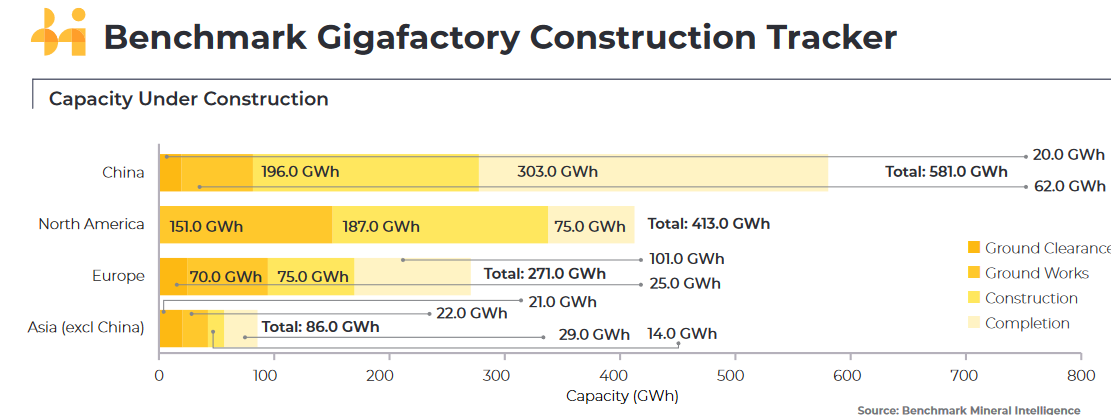
That compares with 14% of Chinese planned battery plants, according to Benchmark.
In addition, the average construction of plants in North America is almost 30 months, compared to just over 20 months for those in China.
Cost increases
Another issue is that US battery producers don’t have such easy access to refined minerals as well as midstream products such as cathodes and anodes as those companies in China.
Battery companies also face rising labour costs, due to negotiations with labour unions.
This summer the union at the Ultium Cells joint venture in Lordstown, Ohio, reached an agreement that will see wages increase by 30% over three years, for example.
For more information about the service this data draws from, get in touch
Want to read more analytical content?
Create a Free Account
Create a free Intelligence account to access 3 content pieces per month.