What is black mass and how is it priced?
:format(auto):focal(center))
As investment in lithium ion battery recycling capacity increases, the pricing and availability of black mass is becoming increasingly important.
This valuable material, a mix of crushed metals produced by shredding battery scrap, is often exported to Asia from the West. But a buildout of recycling plants in Europe and North America could keep more of that material in those regions.
We take a look at what black mass is and how it is priced.
How is black mass produced?
When a lithium ion battery reaches the end of its useful life it is collected for recycling and sent to a pretreatment facility. Here the batteries are shredded. This produces a mixture of materials including scrap metal, plastic waste, and black mass.
“Once you’ve shredded these batteries, you can use magnetic separation and sieving in order to separate out the casing, the electrode foils and the active material mixture that’s known as black mass,” Beatrice Browning, an analyst at Benchmark, said.
The black mass contains valuable lithium, cobalt, nickel and manganese. However, at this stage it can also contain some organic compounds from the electrolyte and binders, so some recyclers put the material through an extra heat treatment step to remove these.
To increase the efficiency of the pre-treatment stage, recyclers will often locate these facilities near areas with large amounts of waste, such as close to a gigafactory or near areas with large amounts of electric vehicles.
For example, Fortum Battery Recycling recently started operations at its hydrometallurgical facility in Harjavalta, Finland–the largest in Europe. This facility will be fed by black mass produced at its pre-treatment facility in Kirchardt, Germany.
Companies that don’t have their own processing facilities then sell the black mass to independent processors or send the black mass on to their partners.
How is black mass priced?
The price of black mass in China, the world’s most advanced battery recycling market, is typically based on payables to the prevailing virgin battery-grade mineral spot prices. As such, black mass prices closely correlate to battery-grade mineral prices.
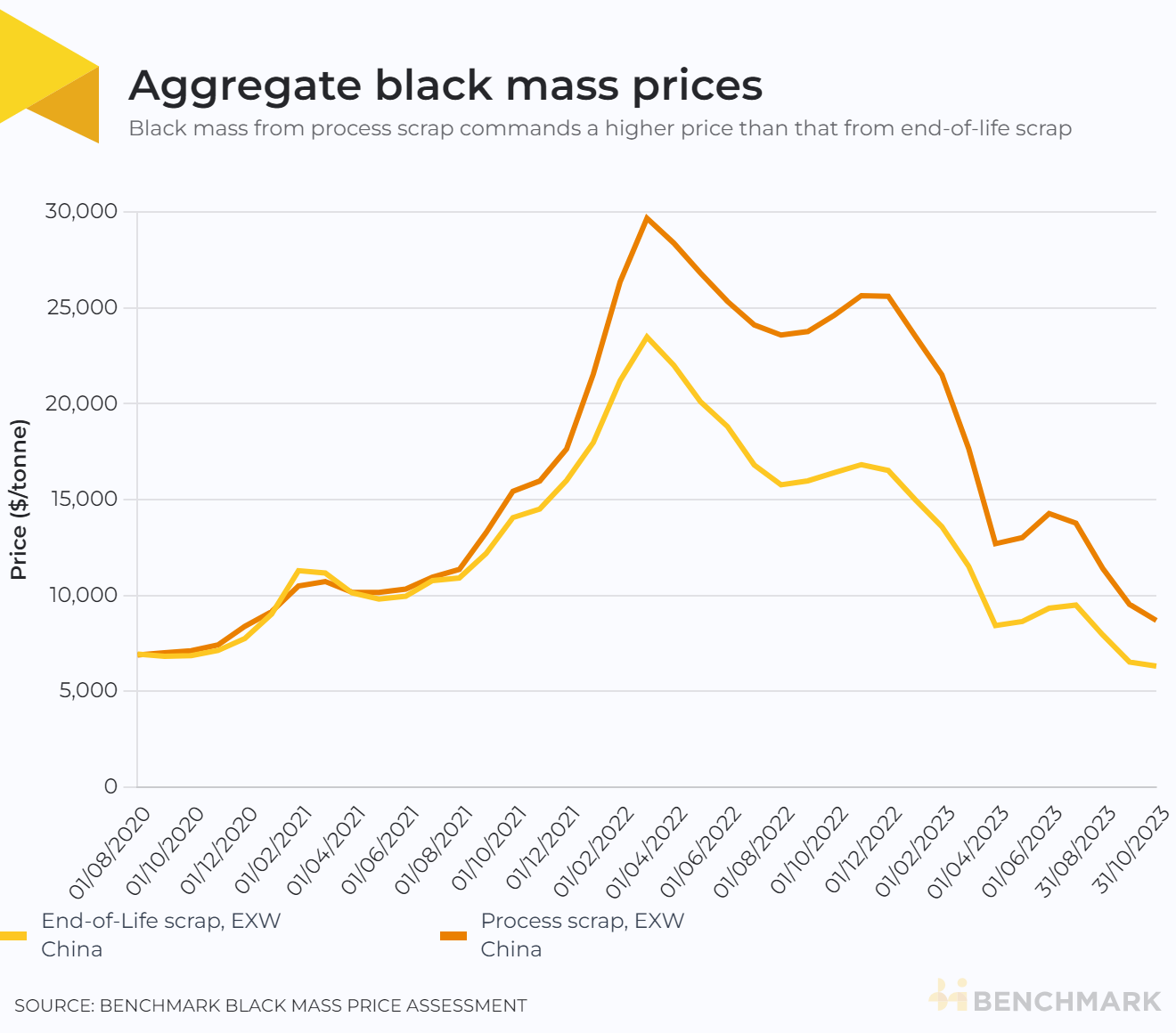
For example, the valuable components of black mass from NCM feedstocks are nickel, cobalt, and lithium. A payable for each mineral will be decided to then derive a price.
“The balance between the payable and the virgin market has to account for the processing costs and recyclers’ margins,” Daniel Fletcher-Manuel, head of prices, data, and indices at Benchmark, said.
In addition to this margin, the balance must typically leave room for the final product to be sold at a discount to virgin minerals due to the increased impurity content. However, some industry players are hoping they may eventually be able to secure a premium given the encouragement of domestic sourcing in North America and Europe.
Whilst lithium is a vital consideration for black mass valuation in China, the extent to which it is factored into Western black mass price varies significantly. If pyrometallurgical techniques are used, then the lithium cannot easily be extracted and is less likely to be considered during pricing.
“Black mass pricing is a summation of only the areas that the processor deems to be economically viable to them in their process,” Fletcher-Manuel said.
An exception to the use of payables is in pricing black mass from LFP scrap. The only truly valuable component of this material today is lithium which is in relatively low proportions with high impurity levels. As such, in Asia, where black mass from LFP is traded today, traders agree on a fixed value based on how much lithium is present.
Black mass from process scrap contains proportionately higher cathode material content and lower impurity levels than end-of-life black mass. This means it can sell for a higher price.
How is black mass regulated?
In many ways, black mass is equivalent to a very high grade ore containing all the minerals for a lithium ion battery.
As such, the material is highly valuable to the regions that produce it. Exporting it outside of the region is effectively losing critical minerals it contains, weakening the domestic supply.
This is particularly common in North America and Europe where battery scrap is processed into black mass that is then exported to Asia, according to Browning.
For example, Posco’s battery recycling plant in Poland disassembles and shreds battery scrap to produce black mass. The material is then exported to South Korea to Posco HY Clean Metal (a joint venture between Posco and Huayou Cobalt) to be processed.
Control of black mass exports is typically achieved through classifying the material as a hazardous waste. Then by regulating the export of materials with certain waste codes, the movement of black mass can be controlled.
“In China, black mass is classified as a hazardous waste material and its importation and exportation has been banned from the region in order to reduce materials leakage,” Browning said.
In September this year, the European Parliament proposed to the European Commission that they “develop dedicated waste codes for lithium ion batteries and intermediate waste streams (black mass).” This would be a first step in reducing the export of black mass outside of Europe.
How is black mass processed?
Black mass is sent to processing facilities to extract the valuable battery minerals. These can be integrated into the same facility that produces the black mass, or can be a separate facility.
Some recyclers use an energy intensive pyrometallurgical process, which heats the material up to extract metals. However, this process loses lithium to the slag waste, so increasingly recyclers are using hydrometallurgical processing.
“This is basically an acid-leaching process,” Browning said. “So say if you were to use sulphuric acid, you can extract out nickel sulphate, cobalt sulphate and manganese sulphate.”
Recyclers can then use a precipitation process to extract lithium carbonate.
Alternatively, a mixed metal hydroxide process can be used to create a nickel, cobalt, manganese (NCM) mixture that is effectively a precursor cathode material. Lithium chemicals can be added to this to produce cathode active material.
Benchmark provides independent price assessments and market analysis for black mass and the battery recycling space.
To learn more about our Black Mass Price Assessment and our Recycling Forecast, please provide your details here and our team will contact you shortly with more information.
For more information about the service this data draws from, get in touch
Want to read more analytical content?
Create a Free Account
Create a free Intelligence account to access 3 content pieces per month.