What policy levers does the US use to limit Chinese EV competition?
:format(auto):focal(center))
As the demand for electric vehicles (EVs) continues to rise, the US government is increasingly concerned about a potential wave of cheap Chinese-made EVs flooding the market and out-competing domestic automakers.
In 2023, 1.4 million new electric vehicles were registered in the US up from 930,000 in 2022. In 2024, Benchmark forecasts this will rise to 1.5 million.
High tariffs helped keep imports of EVs from China at just 3% of the 390,000 total EV imports into the US in 2023. However, Chinese automakers are eying up countries like Mexico as an alternative route into the US.
“This could mean a world where the tariffs on these Chinese vehicles fall to 2.5%, or even to zero if stringent local content requirements are met under the US-Mexico-Canada Agreement,” Bryan Bille, a policy analyst at Benchmark, said.
Parts of the US Inflation Reduction Act (IRA) are designed to help increase the competitiveness of the domestic EV supply chain, though currently the country will be reliant on others for many key aspects.
For example, the new EV registrations forecast for this year will require 98 gigawatt-hours (GWh) of lithium ion batteries. However, Benchmark’s Lithium ion Battery Database shows the US is forecast to produce just 76 GWh.
What policy levers are the US pulling?
Currently, the US imposes a 27.5% tariff on EVs imported from China. However, this tariff drops if the Chinese company instead assembles the vehicle in the US, Canada or Mexico.
BYD Mexico, a subsidiary of the Chinese automaker, plans to build a facility in Mexico, according to a report by Nikkei Asia.The US also has a 15% tariff on Chinese battery cell imports.
In 2022, the US implemented the IRA which included a number of measures to increase the competitiveness of EVs produced in North America.
The $7,500 consumer clean vehicle tax credit in the IRA is only available for vehicles that undergo final assembly in North America and meet increasingly strict sourcing requirements based on the value of the battery components and critical minerals.
From 2024, this tax credit will only be available if none of the components or critical minerals are sourced from a Foreign Entity of Concern–a measure, targeting Chinese involvement, especially with links to the government, in the lithium ion battery supply chain. The final rules are expected to come into force in mid-2024.
Benchmark analysis shows that in 2023, China controlled over 50% of the production of several key battery chemicals. The US and its free trade allies controlled far less of the supply, making it difficult to produce an EV that is eligible for the tax credits.
North America accounted for 4% of global battery production last year, despite accounting for 16% of demand. China, by contrast, produced 85% of battery cells globally, but accounted for just 51% of demand.
Where does the US import EVs from?
Just three countries accounted for 71% of the US’ 390,000 imports of EVs last year: South Korea (29%), Germany (21%), and Mexico (21%). EVs originating in China accounted for just 3% of imports, according to US trade data.
By contrast, the European Union (EU) imported around 2.4 million EVs in 2023, with 60% of the EU’s EV imports coming from China, due to the EU’s lower import tariffs and lack of stringent local content and sourcing requirements in its legislation, like the Critical Raw Materials Act (CRMA).
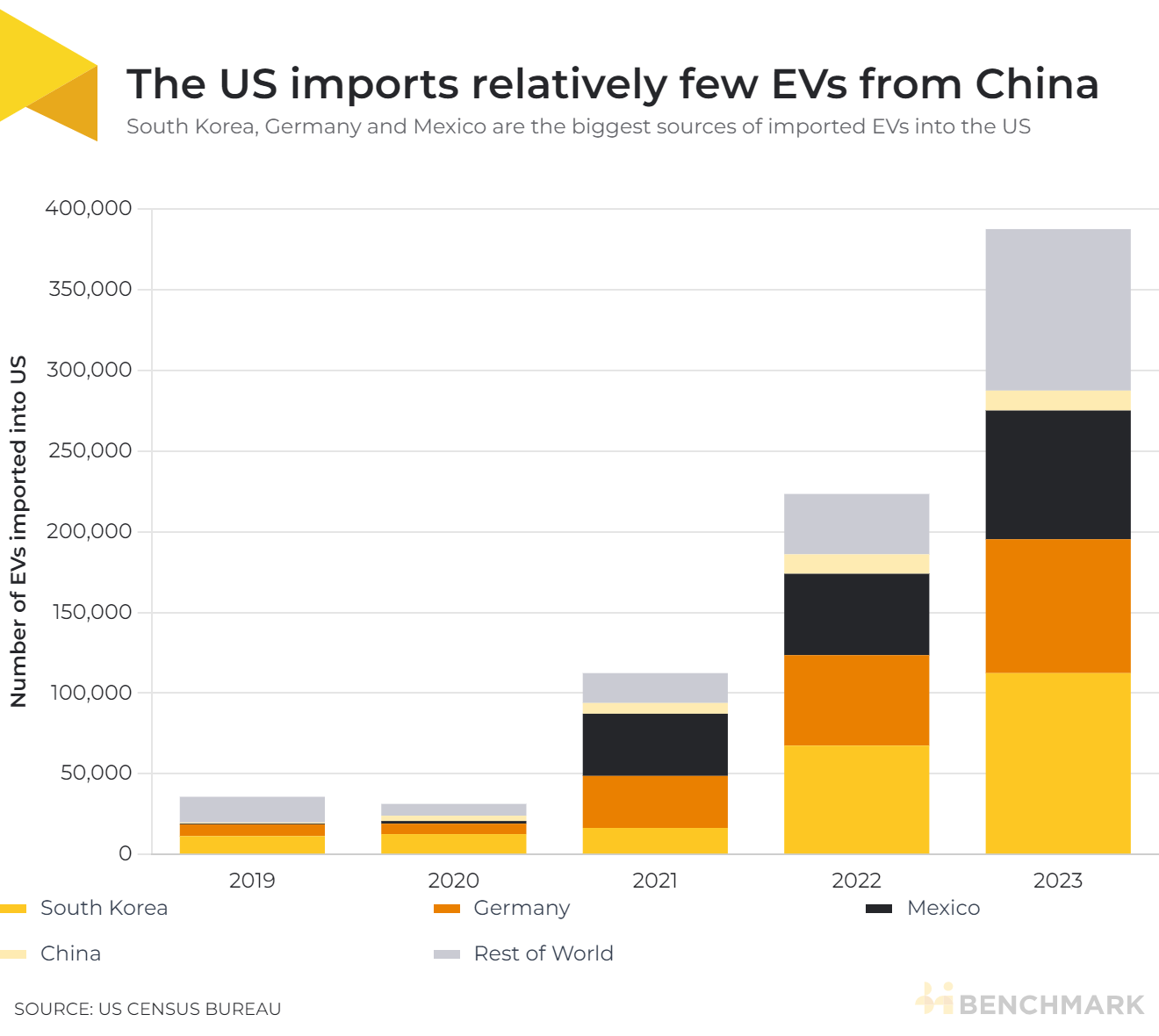
Given the significant imports of EVs from Mexico, BYD and other Chinese automakers plans to set up manufacturing facilities in the country could allow Chinese-made EVs to enter the US without originating in China.
BYD is also considering Morocco as a production base due to the country’s free trade agreements with both the US and the European Union.
“The US car manufacturing industry and US lawmakers see China’s competitive EVs, especially BYD, as ‘an existential threat to America’s auto industry and to US national security’,” Bille said.
Are Chinese EVs cheaper?
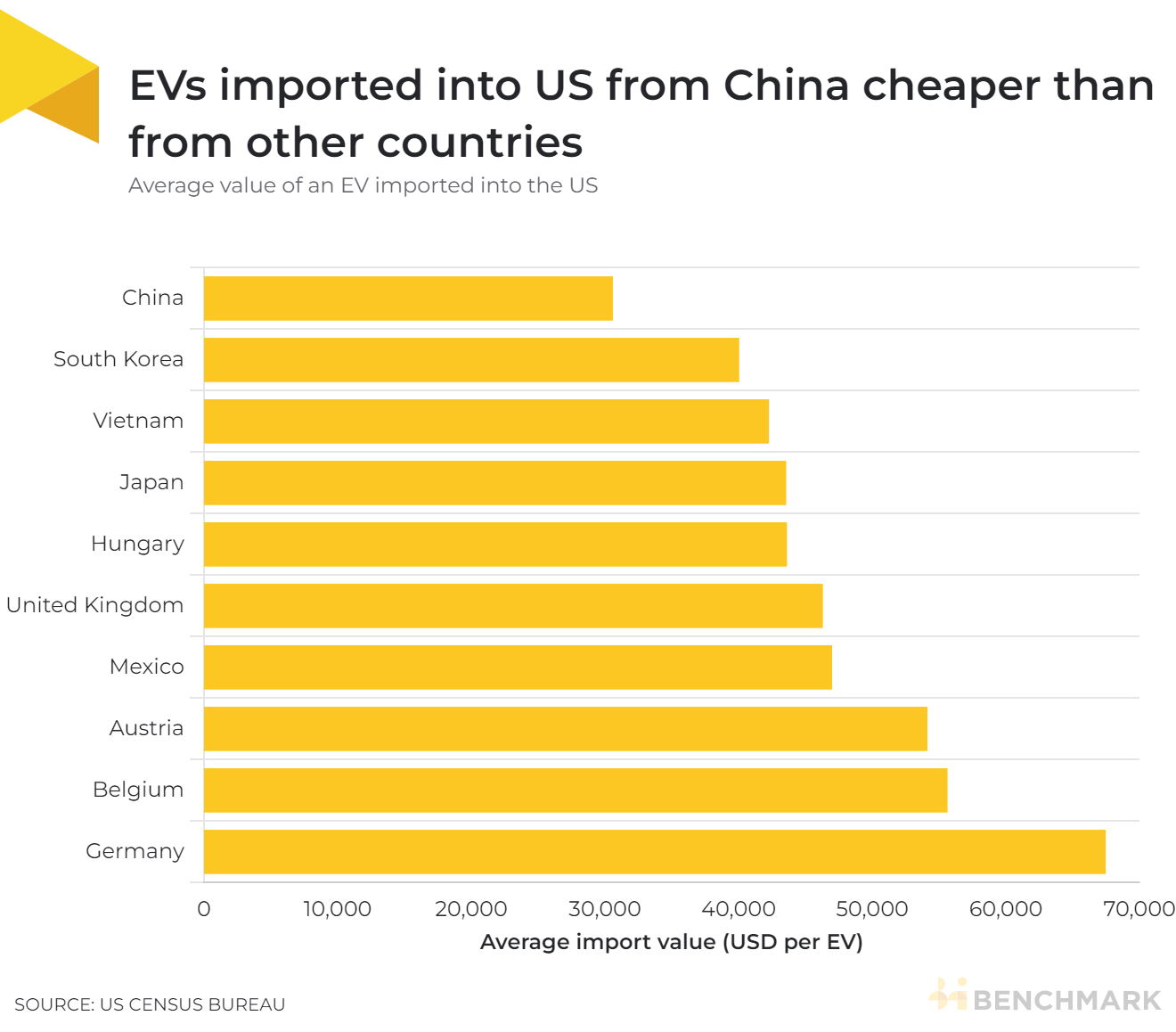
Although the US imports relatively few EVs from China, the EVs that do originate from the country are significantly cheaper.
US Trade data shows that the average EV imported into the US has a value of $49,016. For an EV imported into the US from China the average value is significantly lower at $30,594.
Beyond China’s vertical integration of the supply chain, the country also deploys industrial policy, subsidies and incentives to increase the competitiveness of Chinese EVs. The EU claims these subsidies into the EV sector are unfair and is currently investigating this.
What comes next?
President Joe Biden has ordered an investigation into automotive technologies that could track US drivers as part of a broader strategy to mitigate national security risks associated with foreign technology and EVs.
A potential Trump presidency may result in higher tariffs on cars built in Mexico by Chinese companies for US market sale, according to recent campaign speeches.
“US political pressure, urging the Biden Administration to further restrict imports of China-made EVs to the US market, has been increasing in view of the US elections in November 2024,” Bille said.
What is China’s recent response?
In March, China filed a complaint against the US with the World Trade Organisation. It says that some of the subsidies provided in the IRA are “discriminatory, protectionist and contrary to WTO rules”.
Earlier this month, the US agreed to enter into consultations over the complaint.
Join policy makers and industry leaders from across the EV battery supply chain at Benchmark’s premiere conference, Giga USA 2024.
Click here to find out more about Giga USA and reserve your ticket now.
And, to learn more about Benchmark’s services, including our policy analysis, speak to our experts – please provide your details here:
For more information about the service this data draws from, get in touch
Want to read more analytical content?
Create a Free Account
Create a free Intelligence account to access 3 content pieces per month.