Eramet and Tsingshan open direct lithium extraction plant in Argentina
:format(auto):focal(center))
Eramet commissioned its first Direct Lithium Extraction (DLE) plant in Argentina, marking the first new industrial-scale facility in the country using the technology, which promises to speed up production of lithium.
The plant, a joint venture with China’s Tsingshan, is set to start producing battery-grade lithium carbonate from the Centenario- Ratones salar in November, and ramp-up to full production by the middle of next year. It’s set to have capacity to produce 24,000 tonnes a year of battery-grade lithium carbonate, at a cost of between $4,500 to $5,000 a tonne.
“They’ve developed their own tech, constructed on time and on budget,” Cam Perks, principal consultant at Benchmark, said. “Now the real test begins.”
DLE, which refers to a suite of different technologies for extracting lithium, promises to open up new areas of lithium production, and also increase the speed of lithium extraction from salt flat brines in Chile and Argentina by removing the need for solar evaporation.
Arcadium Lithium currently uses DLE in Argentina at its Hombre Muerto project.
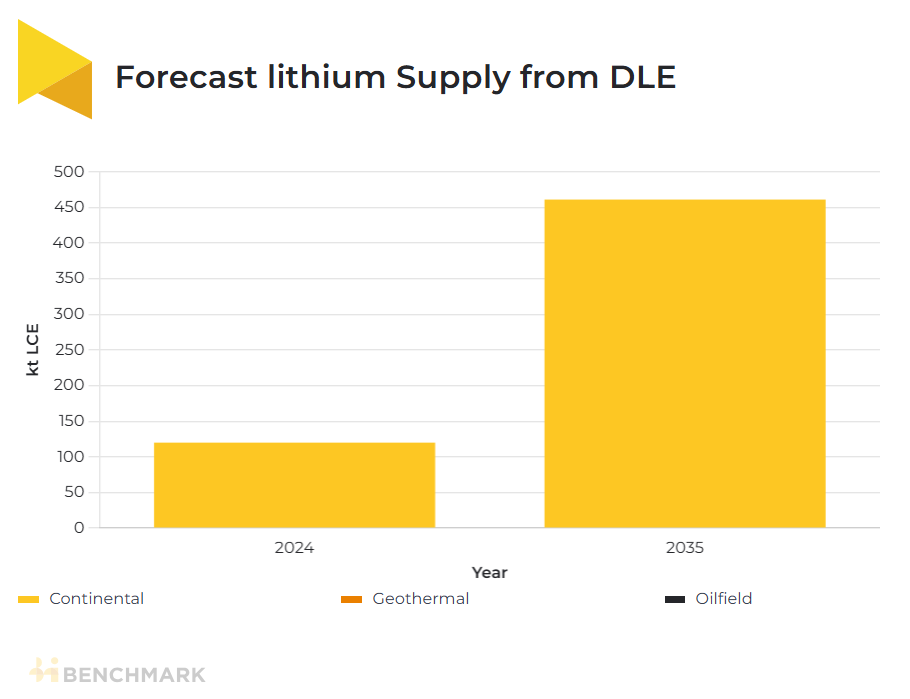
By 2035, DLE is expected to contribute 14% of total lithium supply, of around 470,000 tonnes LCE, according to Benchmark’s Lithium Forecast.
This week Benchmark published a special report on DLE lithium extraction and its role in future lithium supply. Click here to read the full report.
Eramet said the use of DLE shortened the production time for lithium extraction to one week, compared to between 12 and 18 months for traditional evaporation methods in the country.
DLE technology
Eramet is using an aluminium-based adsorbent material, which captures lithium from the brines.
Eramet has said that over 60% of the water used in the process is recycled, and that the company is also exploring direct reinjection of the brine into the salt flat to further reduce water consumption.
Unlike other processes, it doesn’t use acid, and also can operate at the natural temperature of the brine – around 20 degrees centigrade, Eramet said.
The whole process also includes nanofiltration and membrane separation, and has an overall efficiency of around 87%, according to Eramet.
Capital costs
One hurdle to the application of DLE has been the cost to construct and build new plants. Eramet partnered with China’s Tsingshan, however, which has deep experience building plants in Indonesia.
Eramet said the cost of the first phase of its plant, which is at 4,000 metres above sea level, was $870 million. It took three years to construct.
That’s up from an earlier estimate made in 2022 of $735 million.
The estimated cash cost of production for the project has also risen from an earlier estimate of $3,500 a tonne LCE in 2022.
The two companies are also considering building a second phase, which would produce around 30,000 tonnes LCE a year, subject to the obtaining of construction permits. Eramet said it would cost around $800 million.
Eramet owns 50.1% of the project, with Tsingshan holding the remainder of the shares.
For more information about the service this data draws from, get in touch
Want to read more analytical content?
Create a Free Account
Create a free Intelligence account to access 3 content pieces per month.