Global EV sales reach 2.15 million units in September 2026
:format(auto):focal(center))
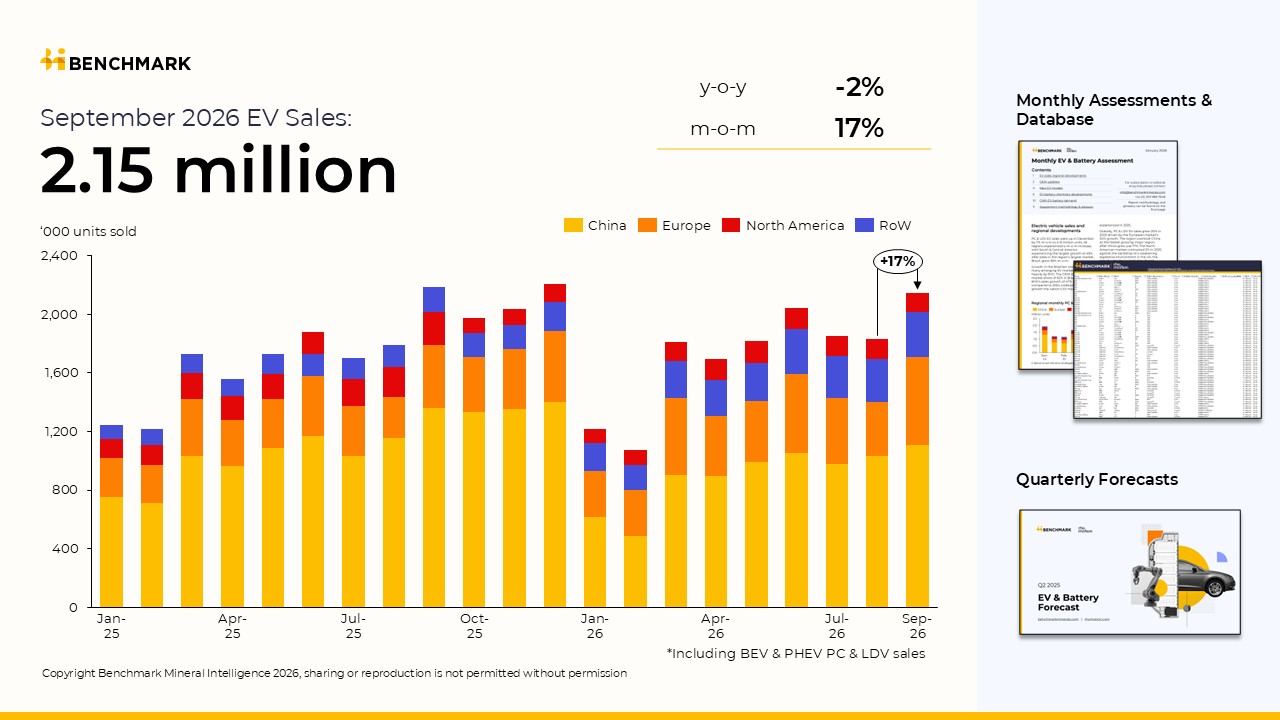
Benchmark Mineral Intelligence, specialising in EV and battery supply chain research and insights, reports that 2.15 million electric vehicles (EVs) were sold globally in September 2026, bringing year-to-date (YTD) 2026 EV sales to 15.5 million. In September 2026, EV sales increased by 17% month-on-month and decreased by -2% year-on-year.
Benchmark Mineral Intelligence Data Manager, Charles Lester, commented:
“Global EV sales rebounded in September, rising 17% month-on-month to 2.15 million units, though they were down 2% year-on-year as a sharper contraction in North America and a weaker domestic market in China outweighed record-breaking sales in Europe. Year-to-date sales now stand at 15.5 million units, up 3% on the same period last year.
“Europe had its strongest month on record, with almost 600,000 EVs sold in September, 10% above the previous high set in June. Sales were up 39% year-on-year, led by battery electric vehicles, which grew 50%, while plug-in hybrids grew a more modest 16%. The UK, France, Spain, Portugal and Finland all posted record monthly EV sales.
“China’s year-on-year decline widened to 18% in September as the domestic market remained weak. Manufacturers have continued to hold production steady and send the surplus overseas, with passenger car NEV exports reaching a new monthly record of 558,000 units.
“North America’s sales fell 44% year-on-year, the steepest decline of the year, as the region was compared against September 2025, the final month before the US federal EV tax credit expired, when buyers rushed to purchase. From the fourth quarter, the comparison will be against the months immediately after the credit’s removal, when US EV sales collapsed, so the year-on-year picture should improve markedly.”
Europe
The European EV market set a new monthly record in September, with almost 600,000 EVs sold, surpassing the previous high set in June 2026 by 10%. Sales rose 39% year-on-year and 62% month-on-month as the market recovered from its summer lull, lifting year-to-date growth to 30%, from 29% at the end of August. Battery electric vehicles drove the growth, with sales up 50% year-on-year, while plug-in hybrid sales rose a more modest 16%.
Growth was broad-based, with most countries in the region posting year-on-year increases. The UK, France, Spain, Portugal and Finland all recorded their highest-ever monthly EV sales. UK EV sales grew more than 3.5 times month-on-month, though this reflects the September new registration plate change, which lifts the overall car market each year. Monthly EV penetration in the UK was broadly unchanged from August at around 40%. France’s EV sales rose 78% year-on-year to almost 80,000 units, while Germany’s were up 61% to 117,000.
Another notable development came on the trade front, as the EU and China agreed to limit imports of Chinese-built hybrids into the bloc. Under the arrangement, which still requires approval from EU member states, imports of Chinese-made full and plug-in hybrids will be capped at 350,000 units a year from 2027 for four years, with the cap rising by 6% annually from the second year. The European Commission expects this to more than halve shipments compared with the up to 800,000 units it estimates China could export to the EU in 2026. The measure targets a fast-growing segment. According to Benchmark data, around 14% of PHEVs sold across the EU, EFTA and UK in 2025 were made in China, and that share has more than doubled to 29% year-to-date in 2026.
North America
The North American EV market contracted 44% year-on-year in September, the steepest decline of the year so far, with sales also down 8% month-on-month. This left the region down 24% year-to-date, from 21% at the end of August. As flagged last month, the decline reflects a comparison against September 2025, when US buyers rushed to purchase EVs ahead of the federal tax credit’s expiration at the end of that month, rather than a fresh deterioration in demand.
The comparison base is set to ease considerably from the fourth quarter. From October onward, year-on-year figures will be measured against the first months without the tax credit in the US, when EV sales collapsed, so the region’s year-on-year declines should narrow significantly.
China
The Chinese EV market’s year-on-year decline widened to 18% in September, from 11% in August, even as sales rose 7% month-on-month. This left the market down 13% year-to-date. The weakness is concentrated in plug-in hybrids, which are down 25% year-to-date, while BEVs have held up better, down just 6%. EV penetration of China’s passenger car market nonetheless remains strong, as the weakness in the wider auto market is weighing on ICE sales at least as heavily.
With domestic demand subdued, Chinese manufacturers have maintained production and continued to export in bulk. Passenger car NEV exports reached a new monthly record of 558,000 units in September. However, two policy changes could weigh on exports next year. The EU hybrid cap described above will restrict PHEV shipments to one of China’s key export markets from 2027. Separately, China will lower the VAT export rebate rate for NEVs from 13% to 9% from 1 April 2027, raising the cost of exporting and putting further pressure on automakers’ overseas profitability.
For more information about the service this data draws from, get in touch
Want to read more analytical content?
Create a Free Account
Create a free Intelligence account to access 3 content pieces per month.