How much would 60 days’ of US battery minerals cost in 2026?
:format(auto):focal(center))
The Trump Administration’s Project Vault aims to create a strategic reserve of critical minerals, funded by $1.67bn in private capital and a $10bn loan from the US Export-Import Bank.
Full details of the reserve have yet to be announced, though the aim is reportedly to build up strategic stocks equivalent to 60 days of demand of selected minerals to protect industries such as automotive and renewable energy against future critical mineral supply shocks and price swings.
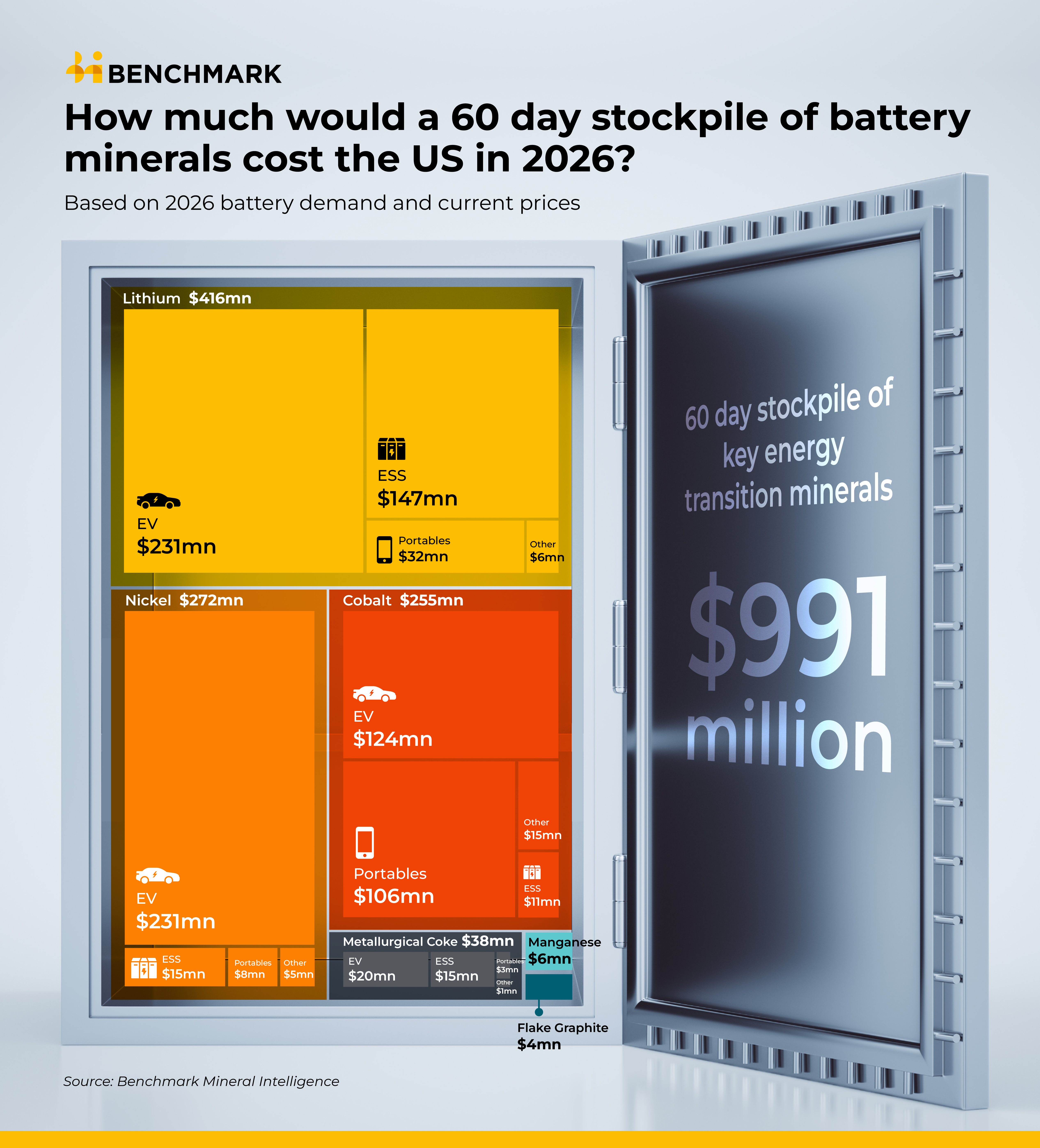
At today’s prices and based on 2026 demand, this would cost $991 million for key battery minerals (lithium, cobalt, nickel, manganese, graphite and coke), with lithium being the largest contributor.
 What is Project Vault?
Project Vault will act as a strategic stockpile. These usually address a specific problem: short-term supply availability during an emergency. In this case, Project Vault intends to absorb sudden supply disruptions by releasing physical material and to provide confidence to key domestic industries that some emergency supply is available within US borders if needed. The initiative echoes the model of the 50-year-old US Strategic Petroleum Reserve, established in the aftermath of the 1973 Arab oil embargo and today holding hundreds of millions of barrels of crude oil in the US.
Commodities trading houses, including Hartree Partners, Mercuria, and Traxys, have agreed to procure minerals for the stockpiles. More than a dozen downstream companies have also committed to participate, including General Motors, Stellantis, Boeing, Google, and GE Vernova. In effect, Project Vault serves as an option-like buffer, as participating companies pay a fee to secure the right to draw from the stockpile in defined emergencies when they are unable to source material from regular markets.
Benchmark Intelligence subscribers can access exclusive policy analysis in the Geo-Economic and Policy Briefing.
How much would other minerals cost?
Beyond battery minerals, Benchmark calculates that 60 days’ worth of US refined copper demand in 2026 at current prices would add $3.7bn to the bill. Demand for rare earths for use in rare earth permanent magnets (REPMs) would cost another $235mn.
In all, the US has 60 minerals on its critical mineral list. As yet, it is unclear whether Project Vault would seek to build a stockpile of all of these minerals, nor whether 60 days would be the target stock level for all the minerals held.
What are the limitations of strategic reserves?
A US strategic reserve does not tackle the underlying issue of upstream supply concentration. Policy measures to derisk domestic and other ex-China projects and improve bankability are required, in addition to building reserves.
Project Vault should be considered as just one tool that can be deployed alongside others such as export restrictions, tariffs, local content requirements, upstream funding, equity investments, and government-backed offtake agreements.
Sources have told Benchmark that without clear guidance and transparent sourcing, there is the risk that the US reserve may itself be dependent on Chinese supplies for minerals such as rare earths, given China’s dominance in those markets.
The insights in this article were produced using data from Benchmark's Price Assessments and Forecasts. For more information, get in touch with the form below:
For more information about the service this data draws from, get in touch
Want to read more analytical content?
Create a Free Account
Create a free Intelligence account to access 3 content pieces per month.