Hungary set to be Europe’s leading tier 1 battery producer this decade
:format(auto):focal(center))
Hungary is set to emerge as the leading tier 1 battery producer in Europe this decade as the world’s top battery makers invest $13 billion to set up gigafactories, drawn by the nation’s more affordable costs and to be closer home to key customers.
Tier 1 battery producers, including CATL and SK Innovation (SKI), are ramping up battery expansion plans in the country to meet demand from Europe’s automakers.
The country’s battery capacity pipeline is set to grow sevenfold to reach 207 gigawatt hours (GWh) by the end of 2031, from 27.5 GWh in 2021, according to Benchmark Gigafactory Assessment. Over 175 GWh, or 86%, of this capacity is set to come from tier 1 battery producers, more than any other country in Europe.
“Hungary offers a source of cheaper labour and land cost when compared with Western Europe. Moreover, the country is well positioned to serve both automaker and EV consumer bases, said Evan Hartley, an analyst with Benchmark.
Tier 1 Chinese producer CATL, the world’s largest battery maker, is alone spending $7.5 billion to build a 100 GWh battery plant in the country to supply its European customers including Mercedes-Benz and BMW. Benchmark assesses tier 1 producers as battery makers that are qualified to supply more than one multinational electric vehicle producer outside of China and have more than 10 GWh of annual production capacity.
Hartley said he believes Eastern European cell capacity is likely to get a further boost as cost is one of the key reasons for many Asian suppliers when deciding where to base operations. Despite aggressive investment plans in Germany, there is still focus on Hungary and Eastern Europe with upstream cathode producers, and downstream EV automakers investing in the country.
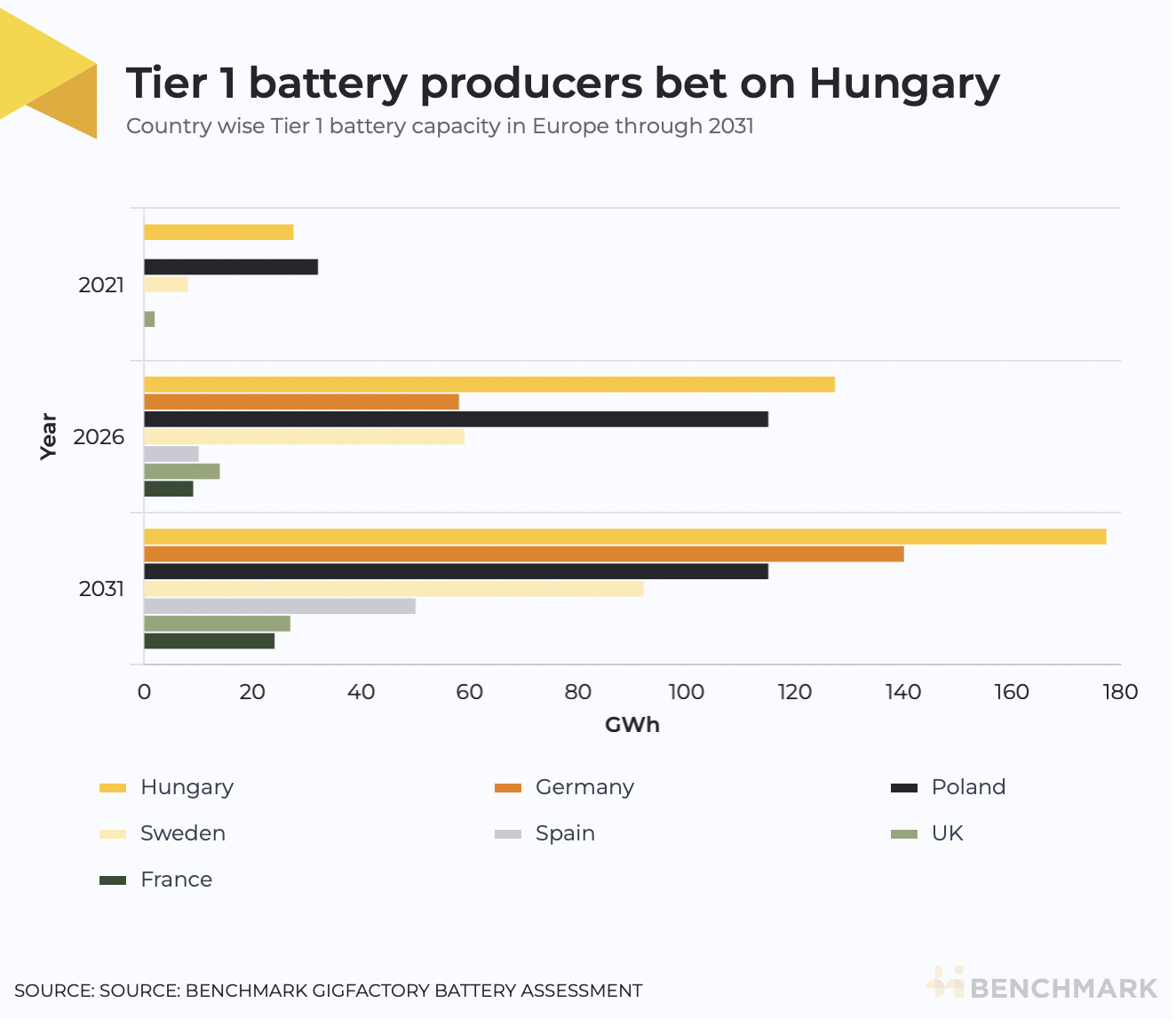
In addition to CATL, South Korea’s SK Innovation is spending $3 billion to build a 30 GWh battery plant and Samsung SDI is spending nearly a billion dollars to expand battery production to 30 GWh by 2026 at Göd, Hungary, near Budapest.
“The Hungarian government has also historically provided subsidies to cell producers, with SKI receiving around EUR 209 million for its 30 GWh plant in Iváncsa, Fejér,” Hartley said.
Further upstream, South Korean cathode maker EcoPro BM last year revealed plans to invest $810 million to set up a factory in Debrecen, Hungary, which Benchmark assesses would account for a quarter of Europe’s production capacity in 2026. The plant is expected to begin production in the second half of 2024.
A Tier 1 supplier establishing cathode and precursor facilities within Hungary will boost cell companies’ ability to produce batteries of the right quality for the European EV market, besides improving the integrity of the supply chain, according to Hartley.
Among automakers, BMW in November said it is doubling investment and will spend over $2 billion to build a battery pack assembly plant in Hungary. Mercedes had in August said CATL’s Debrecen plant in Hungary would supply it the largest initial order volume of battery cells for its European production sites in Germany and Hungary.
“As all the capacity being established in Hungary is being done by Tier 1 and 2 manufacturers, the produced cells will be suitable for use by most European automakers. Even as automakers such as Stellantis, VW, and Renault among others look to bring their own cell capacity online, it is likely that they will continue to supplement their cell supply with material produced across Europe’s cell market,” Hartley said.
For more information about the service this data draws from, get in touch
Want to read more analytical content?
Create a Free Account
Create a free Intelligence account to access 3 content pieces per month.