OPINION: the West needs to support EV demand to achieve supply chain goals
Western politicians have been crystal clear that they want to reduce their reliance on China for clean energy technologies such as batteries.
Yet building a battery supply chain will be difficult to achieve unless measures are taken to support electric vehicle demand.
Currently the electric vehicle market is being propped up by China, meaning that investors in new mines and refineries to supply Western markets have to grapple with serious demand uncertainty.
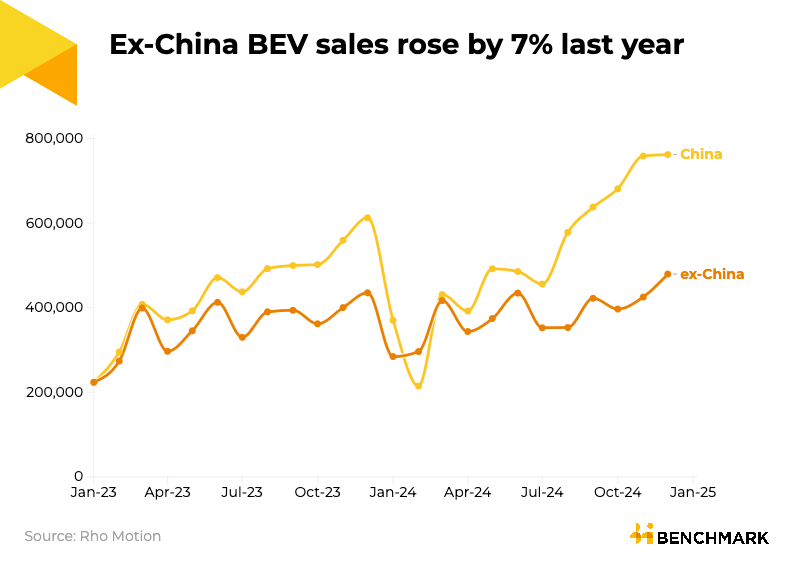
China’s sales of electric vehicles accounted for 65% of the global market last year, including plug-in hybrids (PHEVs), according to Rho Motion. That’s up from 58% in 2023.
Excluding China, sales of pure battery electric vehicles rose by 7% last year from a year earlier. Adding in plug-in hybrid vehicles reduces that growth rate to 6%. That’s hardly the kind of growth that excites mining companies and new investors in the sector.
Having made large investment commitments and big promises a few years ago on the back of political support, many companies are now scaling back plans and cutting spending. Battery plants are being postponed or cancelled in Europe, while miners of critical minerals have scaled back investment plans.
The reality is the energy transition won’t be a nice neat linear demand progression as envisaged by some analysts. But the problem is this demand volatility can seriously damage Western efforts to compete with China during down cycles, setting back geopolitical goals by years.
Importance of policy
The truth is that the electric vehicle market is still heavily reliant on policy. The Chinese market was supported last year by a trade-in scheme for old cars, while the US market was boosted by subsidies in the Inflation Reduction Act.
As Charles Lester, an analyst at Rho Motion, says: “What is clear is that government carrots and sticks are working.”
In China, over 6.8 million old vehicles were replaced through the trade-in program last year, according to Chinese officials. Owners of old cars could get a 20,000 RMB ($2,728) subsidy for trading in an old vehicle for a new energy vehicle (which includes plug-in hybrids.)
This program will be extended into 2025, the government recently confirmed.
Given that the majority of Chinese electric vehicle sales were for vehicles costing between 150,000 and 200,000 RMB ($20,459 – $27,279), the subsidy was quite powerful.
European woes
In Europe, the withdrawal of some electric vehicle subsidies showed how important they are for electric vehicle demand. The removal of EV subsidies in Germany “had a devastating impact on the whole European market” last year, according to Rho Motion’s Lester.
The problem is that there are not enough cheap electric vehicles in Europe to entice buyers without subsidies, and plug-in hybrids have also not been pushed by automakers, unlike in China.
This is partly because of a recalculation of PHEV CO2 emission figures by the European Union, after real-world driven emissions were found to overstate the actual CO2 emitted from a PHEV.
Due to this, sales of PHEVs will not necessarily help automakers avoid billions of euros in emissions fines from the EU.
Yet that may be stopping automakers from producing vehicles that consumers actually want to buy.
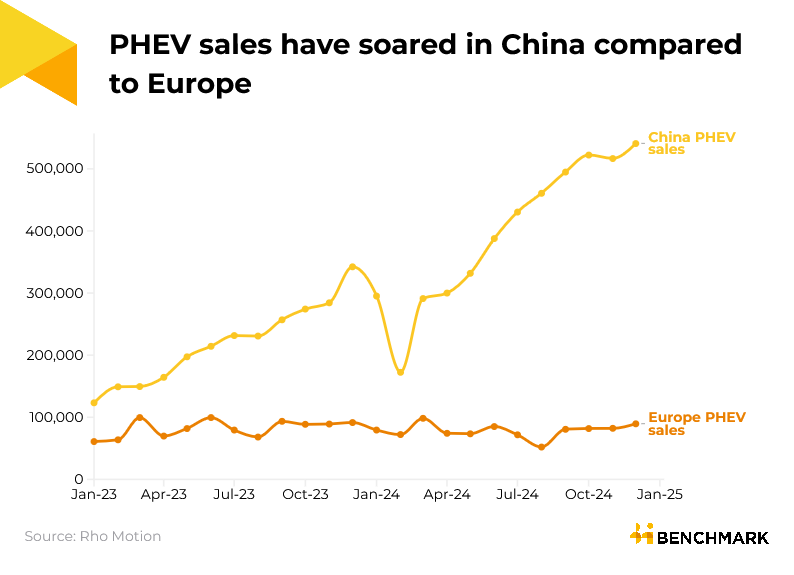
Based on 2024 sales performance automakers in Europe are facing fines totalling well over $15 billion, according to Rho Motion. Benchmark will release a special report on Europe’s emissions legislation this month, available for download on the Source website.
Whither the US EV market
The US should heed the warning from Europe before withdrawing EV subsidies. The big question for this year remains the fate of Biden’s signature climate change policies under President Donald Trump.
According to the Wall Street Journal, Trump plans to immediately order a roll back of automotive emissions rules published by the Environmental Protection Agency.
In addition, he aims to instruct the EPA to cancel its waiver it gave to California, which allowed the state to ban gas cars by 2035.
The key, however, will be whether the consumer electric vehicle subsidies in the Inflation Reduction Act remain. The $7,500 tax credit has spurred a boom in EV leasing, since these cars don’t have to meet stringent battery and critical mineral requirements.
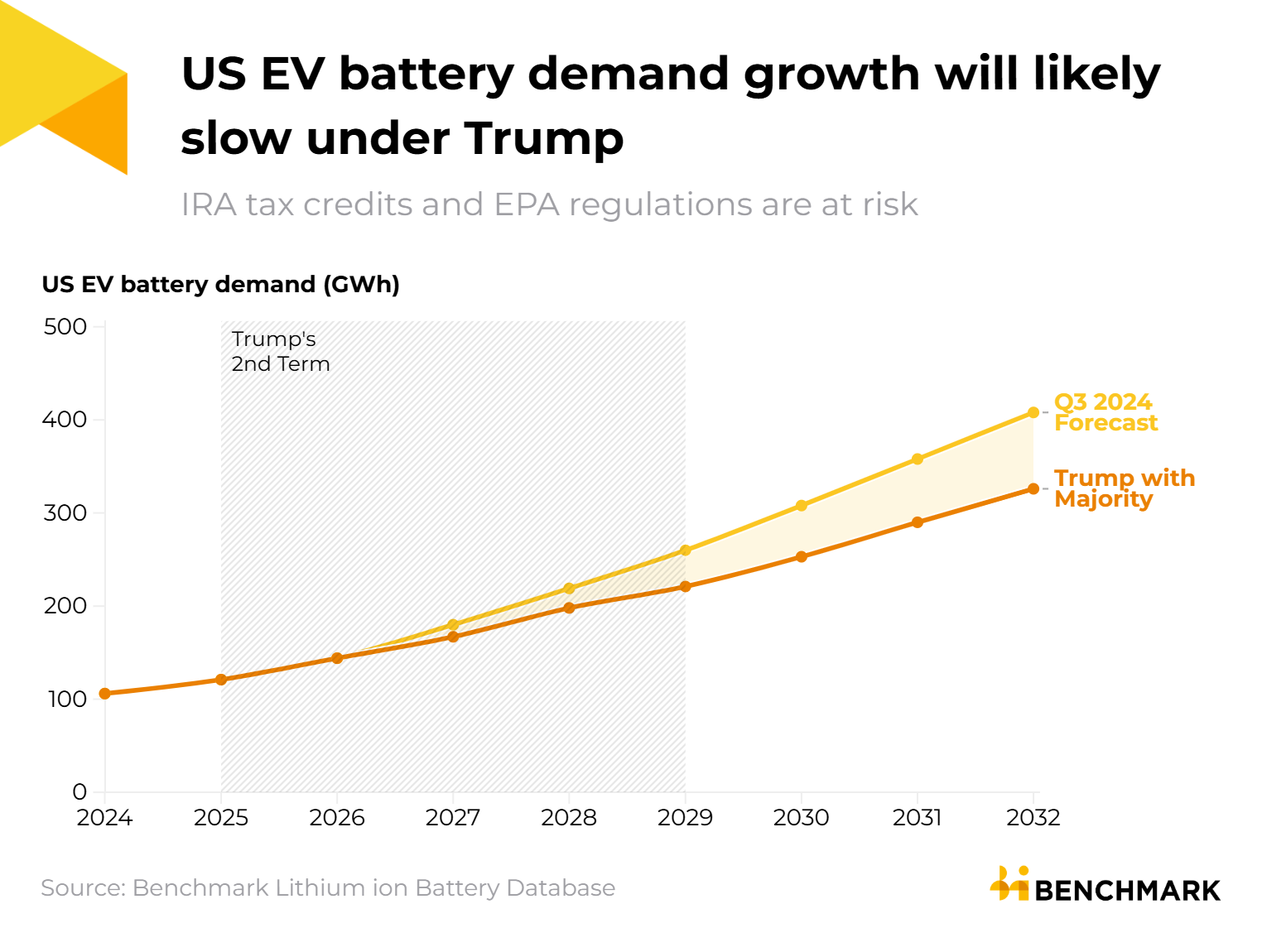
If the US market falters, China will only increase its dominance of global electric vehicle demand.
That, in turn, will reduce the incentive for companies to invest in building a battery supply chain in the West, setting back the broader geopolitical ambitions of countering China’s dominance in critical minerals and batteries.
For more information about the service this data draws from, get in touch
Want to read more analytical content?
Create a Free Account
Create a free Intelligence account to access 3 content pieces per month.