Will 2027 be the year of the solid-state electric vehicle battery?
:format(auto):focal(center))
This decade is key for major automakers and OEMs looking to commercialise solid-state batteries in electric vehicle applications.
Over the past year, several incumbent battery cell producers and automakers have committed to a demonstration of solid-state electric vehicles by 2027 with large-scale production by 2030.
Both of the world’s largest battery makers, CATL and BYD are committed to producing demonstration solid-state vehicles this decade, whilst BYD recently said it was targeting 2030 for mass production.
“Solid-state technologies are in the middle of a four to six year qualification cycle, so these timelines match up well with forecast commercial delivery timelines,” said Rory McNulty, Benchmark’s Product Director for New Technology.
Which companies are committing to solid-state technology this decade?
Although the technologies being qualified today won’t be seen in commercial cars for at least a few years, the end of 2024 saw several Chinese players roll out vehicles with semi-solid-state batteries using traditional anode materials.
“With more expected in 2025, this may have been a catalyst for some of the recent timeline announcements we are seeing,” McNulty said.
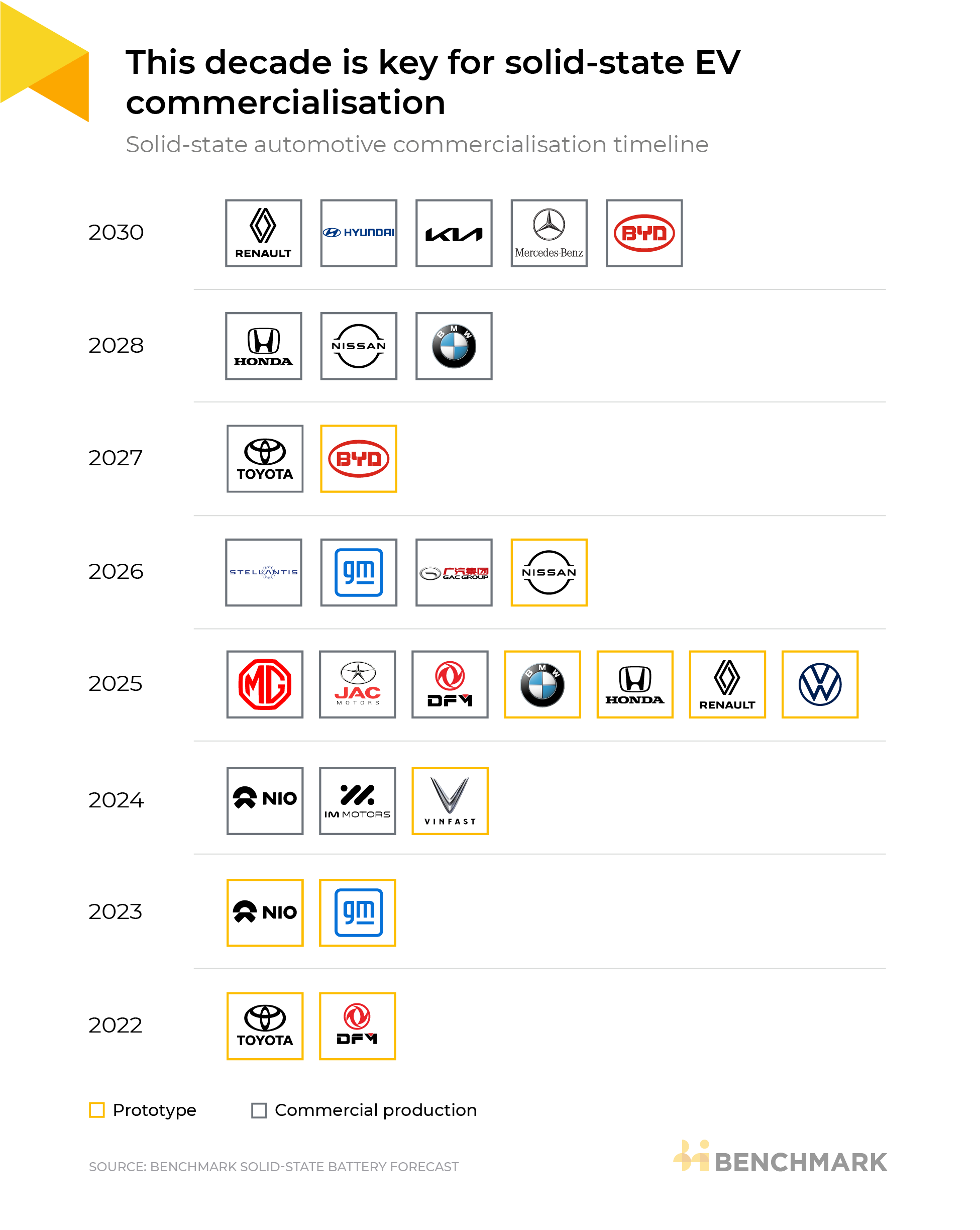
Although automotive timelines represent the industry’s ambition to make the most of the performance gains of solid-state batteries this decade, it is the cell makers who will ultimately enable this.
Samsung, LG Energy Solution, CATL, EVE Energy, and Sunwoda are amongst the largest cell makers that have committed to 2027 to produce solid-state batteries at least at the demonstration scale.
What solid-state technologies are these companies using?
The solid-state batteries currently deployed in vehicular applications use semi-solid-state technologies in which a small quantity of liquid electrolyte is added to improve the contact of the anode and cathode to the solid electrolyte.
They also use more traditional anode materials such as graphite or graphite-silicon composites, meaning the energy density gains aren’t as large as they could be.
“The key differentiator for technologies undergoing qualification today, is that they are looking to employ next-generation anode materials, which could provide a really significant leap in energy density,” McNulty said.
To learn more about trends in emerging battery technologies, download Benchmark’s free special issue, Cheaper, Better, and Smaller: The Future of Battery Technology.
For more information about the service this data draws from, get in touch
Want to read more analytical content?
Create a Free Account
Create a free Intelligence account to access 3 content pieces per month.