Can US and European policy tackle China’s EV dominance?
:format(auto):focal(center))
In recent months, both the US and European Union imposed significant tariffs on electric vehicles imported from China in a bid to boost the competitiveness of their domestic industries.
In May, the US added 100% tariffs to Chinese EV imports, whilst the EU is proposing a near 50% tariff on some Chinese EVs. The US has also imposed additional tariffs on Chinese lithium ion batteries, critical minerals and anode material.
From the perspective of the EU and US governments these tariffs strive to level the playing field to allow more diverse and domestically-centred supply chains to develop without supposedly over-subsidised competition from China.
“The world can hugely benefit if it relies on a more diversified supply chain,” Julia Poliscanova, a senior director at the European NGO Transport & Environment, said during Benchmark’s policy webinar last week. “Everyone wins when competition is good.”
The strength of China
Of the 1.1 terawatt-hours of lithium ion batteries produced globally last year, 85% were produced in China, despite the country accounting for just 52% of global battery demand.
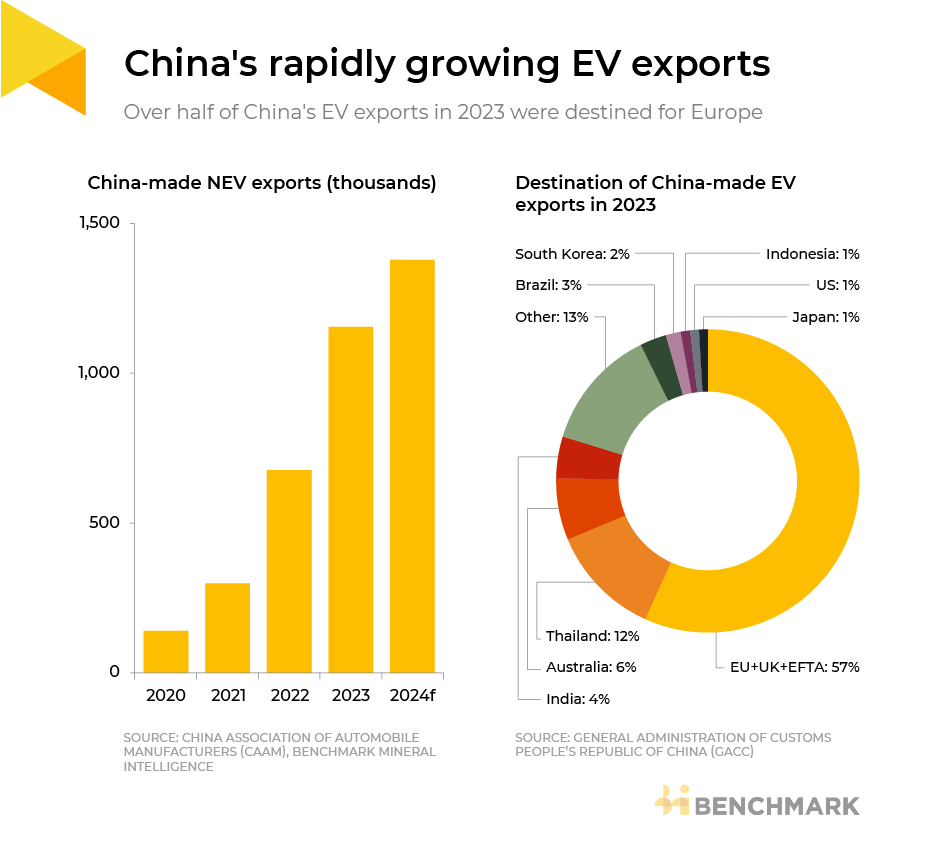
This strength in battery production feeds into China’s strength in EV production. In 2023, China exported 1.2 million EVs and is forecast by Benchmark to export 1.4 million this year. The majority of these were to Europe, with just 1% to the US.
China scaled these technologies faster than any other region and dominates the majority of the supply chain. It achieved this through proactive policies to incentivise the build out of capacity and state support.
The call for tariffs
However, China’s capacity has grown faster than its domestic demand leading to overcapacity and fierce price competition.
“The worry for the rest of the world is that China looks to export markets when domestic demand proves insufficient,” Jonathan Humphrey, a senior economist at Benchmark, said during the webinar.
The European Union argues that the state support China provides for EVs that get exported to the bloc amounts to unfair subsidisation. The US also believes that China’s practices are anti-competitive.
Thus, both the EU and US have proposed or imposed tariffs on the imports of Chinese EVs to supposedly level the playing field.
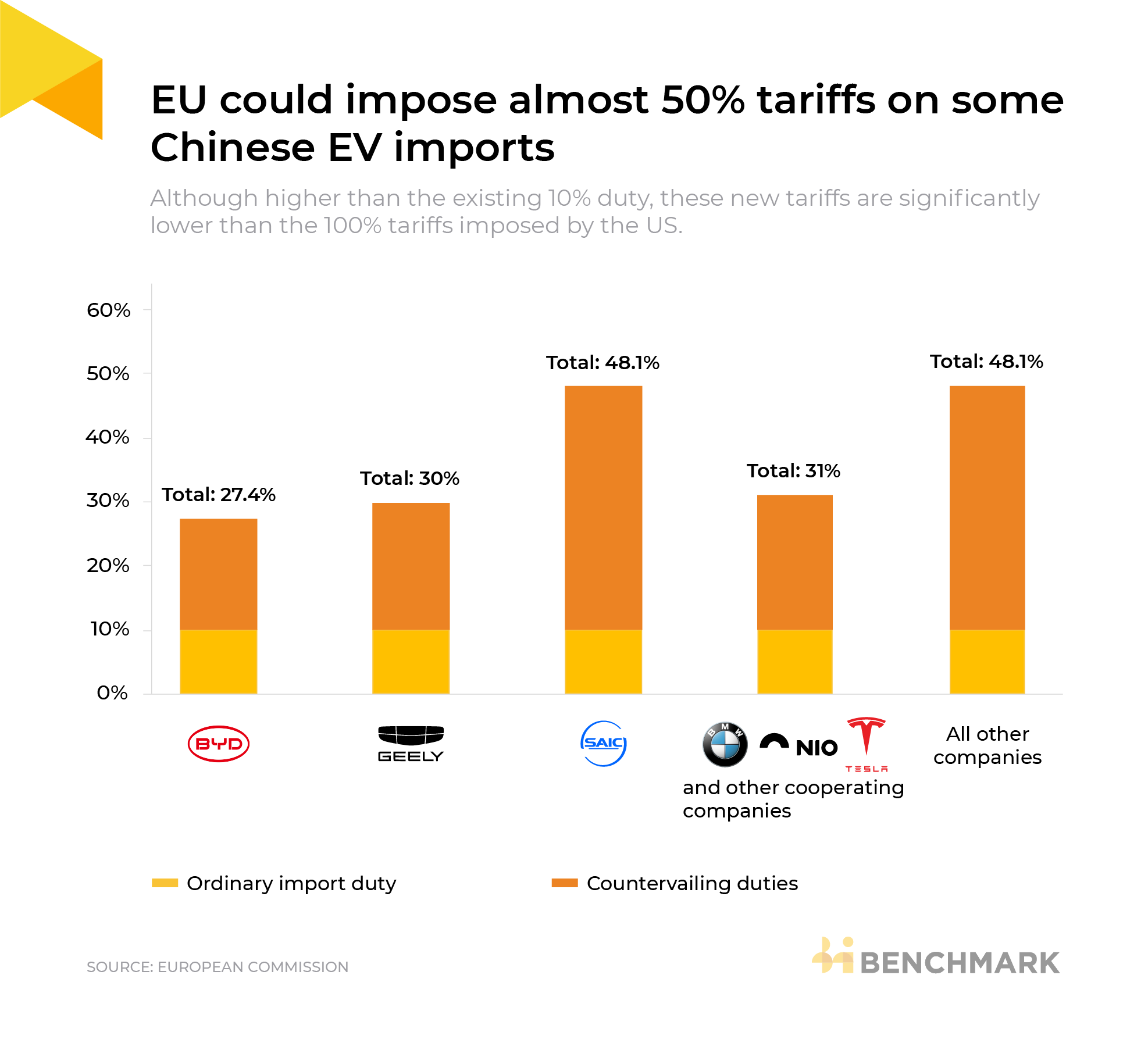
However, tariffs could increase the price of EVs for consumers amidst already slowing growth in EV demand.
“Short term, there will be some knockdown effects on pricing,” Poliscanova said. “However, I think we shouldn’t forget just how much of the margins and pricing power many Chinese OEMs such as BYD have.”
Poliscanova argues that despite this, the tariffs help to achieve the goals of green transition policies.
“The European green agenda has come with a promise of green jobs, new jobs and green growth,” she said. “And if the entire transition is relying on imported technology, those jobs won’t materialise.”
Policy beyond tariffs
Tariffs are just one instrument that policy makers can deploy to discourage Chinese imports and encourage the build out of domestic supply chains.
The US released its industry-changing Inflation Reduction Act in August 2022, which quickly resulted in a flurry of gigafactory announcements in the country.
The EU has opted for a less incentive-laden approach to its domestic green industries. Instead, the bloc has deployed the Net-Zero Industry Act, Battery Regulation and the Critical Raw Materials Act to encourage the domestic build out of a battery ecosystem through regulatory frameworks.
“Smart regulation is a good way to go: It can attract investment,” Poliscanova said. “And from the consumer point of view, it’s actually the most cost effective way to scale products.”
But regulation can only go so far to tackle competition from a country as dominant as China.
“I do believe right now, given the subsidies in China and given the US IRA, just relying on regulations in Europe is simply not good enough,” Poliscanova said. “We do need a lot more investments.”
Benchmark Source subscribers can watch all of Benchmark’s webinars, conference presentations, industry interviews, and insights from our analysts on demand.
Fill in the form below to learn more or request a free trial of Benchmark Source:
For more information about the service this data draws from, get in touch
Want to read more analytical content?
Create a Free Account
Create a free Intelligence account to access 3 content pieces per month.