Critical mass: Asian demand for North American scrap sees recycler prices spike
:format(auto):focal(center))
Competition for North American black mass is increasing as Asian recyclers look to the region to secure material for their facilities. Black mass contains critical battery minerals and is produced by processing battery scrap.
Aggregated North American black mass price in May rose 10.11% month-on-month to $5,758 per tonne (EXW NA) on the back of rising demand from Asian recyclers, according to Benchmark’s Black Mass Price Assessment.
Domestic North American recyclers are struggling to compete with these high prices, increasing the risk that the critical minerals contained within the black mass could leak out of the region. As such, securing black mass material is of great importance.
“With competition for black mass feedstock heating up in Asia, escalating procurement in the North America market from Asian market participants is pushing North American payables to new highs,” Frederick Bloomfield, a black mass pricing analyst at Benchmark, said.
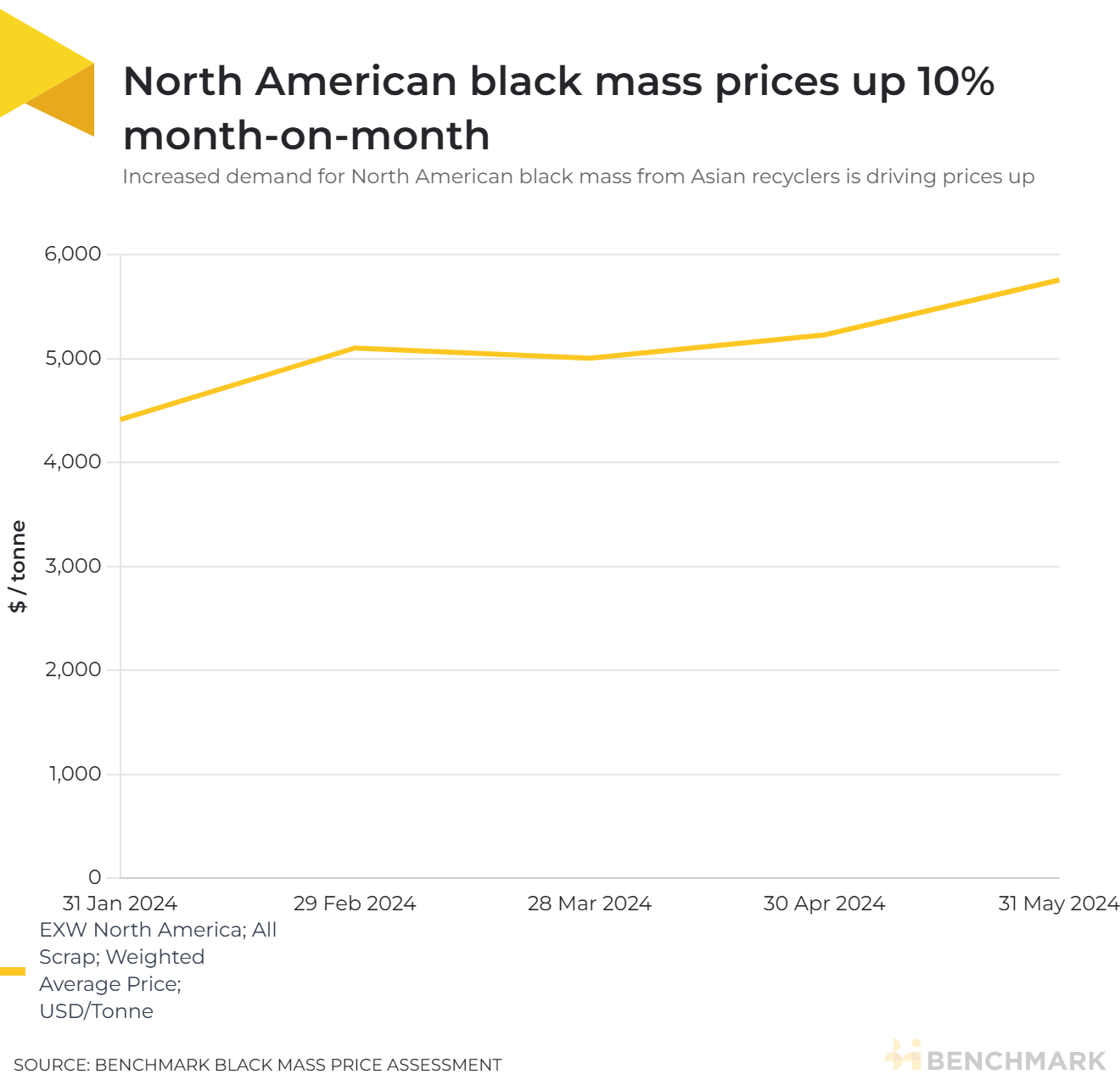
Benchmark reports that in May cobalt and nickel metal payables for North American nickel cobalt manganese (NCM) feedstock black mass were 77%, up from 70.5% in April.
Why are prices rising?
Globally, and especially in Asia, there is a significant overcapacity for black mass processing due to the high amount of hydrometallurgical recycling capability within this region and a relatively low volume of black mass available worldwide.
This results in a very active sellers market for black mass. Buyers have limited scope in the Asian market to negotiate black mass prices, according to Benchmark’s Black Mass Price Assessment.
Heightened competition for black mass has now spread into North America as well. Indeed, Benchmark notes that some North American recyclers are struggling to secure domestic supplies as prices are beginning to resemble the prices Benchmark has reported for the CIF Asia Market.
As a result, some North American recyclers are starting to secure black mass from Europe instead. For now, this has not significantly driven up prices for European black mass.
“It is expected that this will push European prices up to the levels we see in North America, especially if traders manage to circumvent current issues with hazardous waste shipments out of the EU,” Bloomfield said.
What are recyclers doing about this?
A stable supply of feedstock is vitally important for a recycler. This normally takes the form of battery scrap for shredders and integrated recyclers.
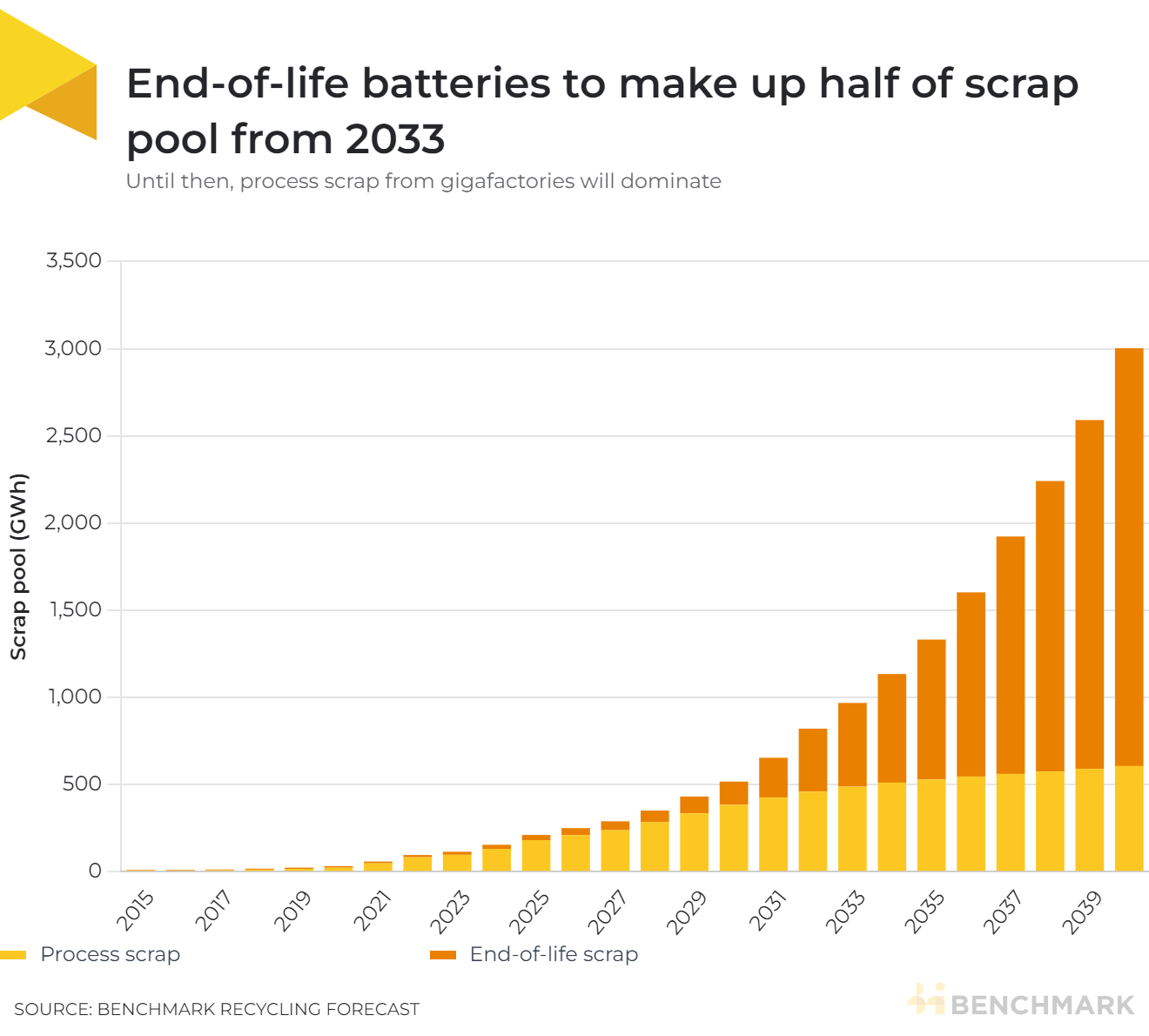
Although several recyclers have been making deals with automakers to recycle their end-of-life batteries, process scrap from gigafactories will be the primary source of battery scrap until the mid-2030s, according to Benchmark’s Recycling Forecast.
Process scrap is generated by gigafactories at a variety of production steps: electrode manufacture, cell assembly, and cell finishing. Scrap from the former stages is not yet in cell form so can be easier to process.
Watch Benchmark analyst Beatrice Browning explain what black mass is in this video on Benchmark Source.View more analyst insight videos here.
In the near term, process scrap will be the primary source of feedstock for the battery recycling industry. From the mid-2030s, end-of-life scrap will take over as the main source of feedstock as electric vehicles reach their end-of-life.
“In order to obtain a secure supply of recycling feedstock, partnering with a cell manufacturer is extremely beneficial for a recycler, particularly in the short-term where scrap volumes are low and process scrap is set to dominate,” Beatrice Browning, a recycling analyst at Benchmark, said.
Last month, Redwood Materials secured a deal to source process battery scrap from the US gigafactories operated by Ultium Cells, a joint venture between General Motors and LG Energy Solution.
Redwood Materials is a US-based integrated recycler. It aspires to produce battery-grade materials from battery scrap.
“This is significant for the US’ critical material supply as currently there is a global overcapacity for black mass processing,” Browning said. “With Redwood’s procurement of this feedstock this can ensure materials leakage for recycling is limited.”
In February, Sweden-based Stena Recycling announced a similar agreement to Redwood’s to manage the process scrap from Morrow Batteries’ gigafactory in Norway.
Benchmark provides a Black Mass Price Assessment with 27 prices updated on a monthly basis. To request a sample report please provide your details below:
For more information about the service this data draws from, get in touch
Want to read more analytical content?
Create a Free Account
Create a free Intelligence account to access 3 content pieces per month.