Global EV sales reach 2.0 million units in June 2026
:format(auto):focal(center))
Benchmark Mineral Intelligence, specialising in EV and battery supply chain research and insights, reports that 2.0 million electric vehicles were sold globally in June 2026, bringing YTD 2026 EV sales to 9.6 million. In June 2026, EV sales increased by 7% year-on-year (y-o-y) and by 11% month-on-month (m-o-m).
Benchmark Mineral Intelligence Senior EV Analyst, George Whitcombe, commented:
"The global EV market’s regional divergence continued in June 2026. Europe remains the main engine of growth after another record month for EV sales bring year-to-date growth up to 27% compared to the same period in 2025. This growth is supported by legislative drivers, subsidies and elevated fuel prices. However, an increasing number of small segment EVs from European vehicle manufactures are entering the market and ramping production. With these small EVs strongly supported by legislation in the region they are an area to watch in terms of supporting growth in the coming months and into next year.”
"China’s vehicle manufactures continue to accelerate their EV export pivot as the domestic market remains down 14% year-to-date. These manufacturers are increasingly looking to expand further into the global market to offset the subdued domestic environment.”
"The North American EV market remains hampered by weaker legislative drivers and a lack of subsidy support in the US, leaving the region’s EV sales down 20% year-to-date. Overall, the global EV market continues to be defined by its mixed trajectory amid changing policy environments and China’s EV export push.” 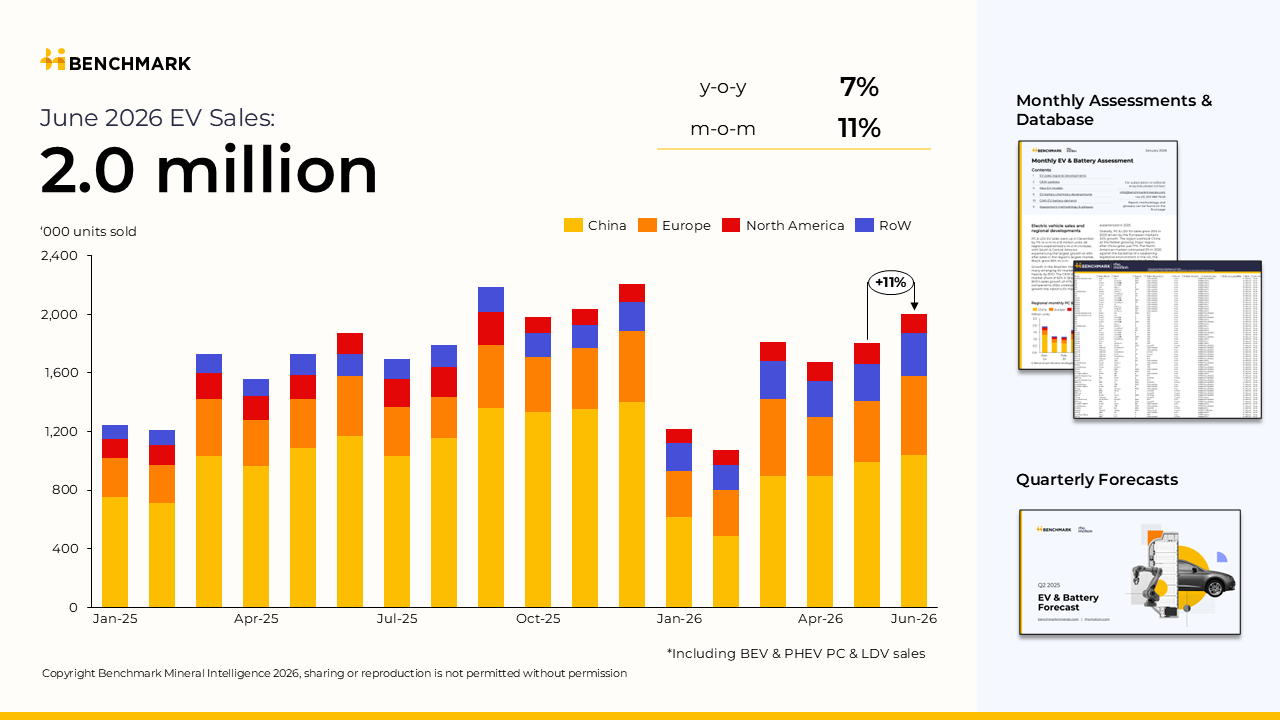
Europe
June 2026 was a record month for EV sales in Europe after sales grew 28% m-o-m and 31% y-o-y. This growth continues to be supported by legislative drivers and several national level subsidy schemes within the region. The market’s exceptionally strong performance in June is also in part a consequence of elevated fuel prices following the conflict in the Middle East; as EVs purchased in the immediate outbreak of the conflict are now being delivered.
France, Denmark, Spain and Portugal all achieved record monthly EV sales in June. France surpassed its previous high from December 2025 by 14%. Despite the growing presence of Chinese EVs in Europe, French consumers remain loyal to domestic brands. Renault accounted for four of the five best-selling EVs in France in June and held an EV market share of 20%. Renault’s recently released small segment EVs are proving popular, with the new Twingo being France’s third best-selling EV in June despite only starting meaningful deliveries in March.
In June, VW Group began deliveries of its new ‘Electric Urban Car Family’ set of EVs within Europe, having started series production earlier in the month. The Volkswagen ID.Polo and Cupra Raval entered production in Martorell, Spain. Assembly of the Skoda Epiq started at the automaker’s facility near Pamplona, Spain, the same site that will also produce the Volkswagen ID.Cross from later this year. Electrification in Europe has historically focused on larger vehicles, in part a consequence of achieving profitability. However, this generation of small EVs that are currently entering the European market have been built on EV specific platforms, which enables vehicle manufacturers to now deliver profitable EVs in the small segment. Early signals suggest these new small EVs will prove popular with European consumers.
North America
Amid weaker legislative drivers and the removal of the EV tax credit in the US in September, the contraction of the North American EV market persists. EV sales in the region are down 20% YTD after the first half of the year, with local vehicle manufacturers’ EV sales remaining weak following strategy pivots and significant write-downs. In the USA, all-electric vehicle sales by GM and Ford are down YTD more than all-electric vehicle sales in the market as a whole.
Lotus shipped its first Eletre EVs from China to Canada in early July. These are the first EVs made in China to enter Canada under its tariff quota agreement that allows 49,000 Chinese-built EVs to enter Canada at a lower tariff rate, down from the previous 100% surtax.
China
While the Chinese EV market had started to recover from its slow start to the year in recent months, this recovery has begun to slow with EV sales down 11% y-o-y in June and the market remaining 14% down YTD.
Chinese vehicle manufacturers continue to increase their NEV exports, with another monthly record in June at almost 500,000 units. Chinese OEMs are increasingly looking to expand further into the global market to compensate the EV sales decline in the domestic market.
Europe is a key market several Chinese OEMs are looking to enter. They first sought to do this through BEV exports. However, the European Commission subjected Chinese BEVs to countervailing duties in late 2024, prompting several Chinese vehicle manufacturers to turn to PHEVs for sales growth in the region. In 2025, sales of PHEVs made in China increased more than four-fold compared to 2024 in the EU and sales have risen significantly again in 2026. The European Commission is now looking to impose additional countervailing duties on PHEVs made in China, with an anti-subsidy investigation reportedly underway.
For more information about the service this data draws from, get in touch
Want to read more analytical content?
Create a Free Account
Create a free Intelligence account to access 3 content pieces per month.