Global EV sales reach 2.09 million units in October 2026

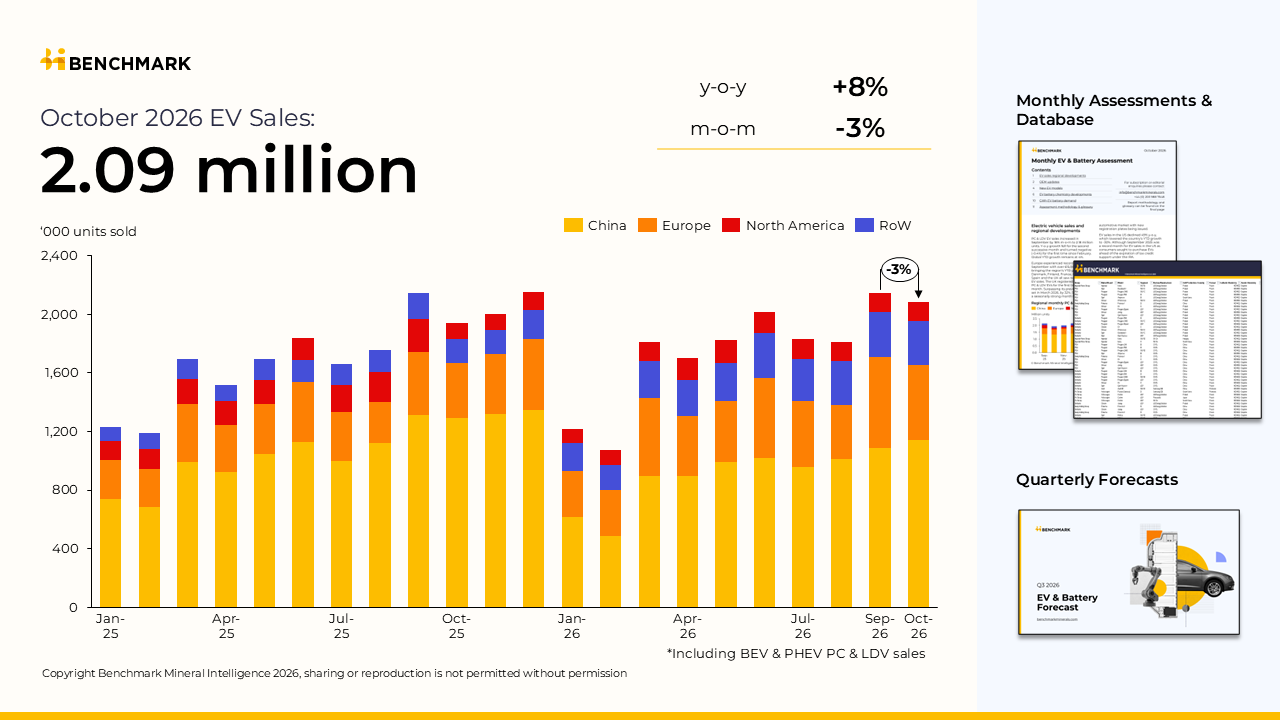
Benchmark Mineral Intelligence, specialising in EV and battery supply chain research and insights, reports that 2.09 million electric vehicles (EVs) were sold globally in October 2026, bringing year-to-date (YTD) 2026 EV sales to 17.5 million. In October 2026, EV sales increased by 8% year-on-year and fell by -3% month-on-month.
Snapshot electric vehicle sales YTD 2026 (Jan-Oct 2026). Includes both BEV and PHEV sales for the passenger car and light duty vehicle market.
Benchmark Mineral Intelligence Data Manager, Charles Lester, commented:
“Global EV sales slipped 3% month-on-month to 2.09 million units in October but returned to year-on-year growth, up 8%, as North America posted its first annual increase of the year and growth in Europe continued to build. Year-to-date sales now stand at 17.5 million units, up 5% on the same period last year.
“Europe’s growth is still building, with sales up 36% year-on-year in October, ahead of the 31% year-to-date pace. Battery electric vehicles led the way, up 49% year-on-year, while plug-in hybrids rose a more modest 7% year-on-year. Germany posted its highest EV penetration since December 2022 (when buyers rushed to purchase ahead of EV subsidy cuts at the start of 2023), and the UK grew 30% year-on-year despite comparing against a period when its Electric Car Grant was already in place.
“North America returned to year-on-year growth for the first time this year, but this is not an entirely positive story. October is the first month compared against a period without the US federal tax credit, and the US market has stabilised at a lower level rather than recovered.
“China’s year-on-year decline narrowed to 12% as manufacturers continued to lean on exports, with passenger car NEV exports reaching almost 600,000 units, another monthly record.”
Europe
The European EV market sold 510,000 EVs in October, up 36% year-on-year and down 17% month-on-month following September’s all-time high, which was boosted by the UK’s September registration plate change. Growth is still building, with the monthly year-on-year rate continuing to run ahead of the year-to-date pace, which edged up to 31% from 30% at the end of September. Battery electric vehicles again drove the market, with sales up 49% year-on-year, while plug-in hybrid sales rose just 7%.
Germany recorded its highest EV penetration rate since December 2022, with EVs taking more than 45% of the new car market for the first time since then. German BEV sales rose almost 80% year-on-year to more than 95,000 units.
UK EV sales grew 30% year-on-year. The strength of this growth stands out because the UK’s Electric Car Grant was already in place in October 2025, meaning the market is now growing against a subsidised base, although fewer models qualified for the scheme at that time.
Portugal’s EV penetration reached 55% in October, after rising sharply over the last few months, placing it among the most electrified car markets in Europe.
North America
The North American EV market returned to year-on-year growth in October, with sales up 24%, the region’s first annual increase of 2026. Sales were flat month-on-month at 130,000 units, and the year-to-date decline narrowed to 21% from 24% at the end of September.
US EV sales reached around 110,000 units in October. This is the first month compared against a period without the federal EV tax credit, which expired at the end of September 2025, after which US EV sales collapsed. The return to growth therefore reflects the easier comparison base more than a recovery in demand. US EV sales have stabilised since the credit’s removal, but at a lower level than before it expired, and the market has effectively been reset to a smaller base.
China
The Chinese EV market’s year-on-year decline narrowed to 12% in October, from 18% in September, with sales up 5% month-on-month to 1.14 million units. This left the market down 11% year-to-date, compared with 13% at the end of September. EVs continue to take a growing share of a shrinking domestic car market, as the wider passenger car market is falling more steeply than EV sales, pushing EV penetration to a new high.
With domestic demand still subdued, Chinese manufacturers have maintained production and continued to export in volume. Passenger car NEV exports reached almost 600,000 units in October, a new monthly record, up from 558,000 in September. The policy headwinds for 2027 remain in place: the EU’s cap on imports of Chinese-built hybrids, and the reduction in China’s VAT export rebate for NEVs from 13% to 9% from 1 April 2027.
Rest of the World
Sales in the Rest of the World rose 85% year-on-year to 300,000 units in October, leaving the region up 93% year-to-date.
Australia’s EV sales were up more than 200% year-on-year in October, and EV penetration has climbed sharply this year. However, this growth has not translated into healthy profits for dealers. A surge in new car brands entering the market, many of them Chinese, is fragmenting sales across more brands and squeezing dealer margins.
Brazil has also seen huge growth this year, but much of it has been driven by factors that may not last. The phased increase in import tariffs encouraged high imports ahead of each step-up, the fuel crisis boosted demand for EVs, and BYD has ramped up production at its local plant. Once the higher tariffs are fully in place and fuel price pressure eases, BYD’s local production, which will also serve Argentina and Mexico, will be the main remaining support. After this period of extreme growth, the drivers of Brazil’s EV market look set to ease.
For more information about the service this data draws from, get in touch
Want to read more analytical content?
Create a Free Account
Create a free Intelligence account to access 3 content pieces per month.