Ex-China rare earths premium to grow, especially for heavies
:format(auto):focal(center))
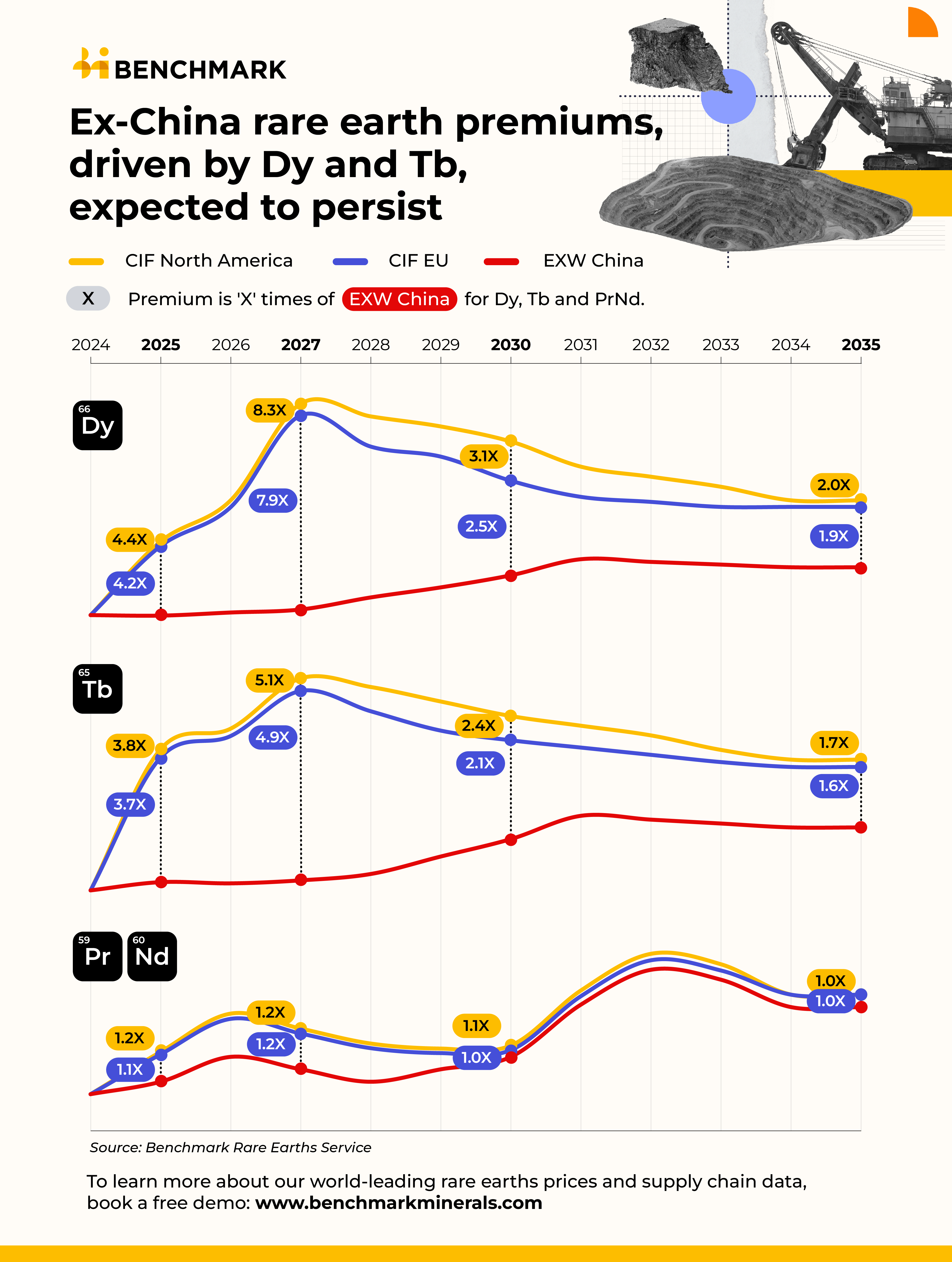
Since China introduced export restrictions on rare earths in April 2025, significant regional bifurcation of heavy rare earth prices has developed. In 2025, dysprosium oxide prices on a CIF North America basis were 4.4 times that of EXW China prices, with a similar difference for European prices in terbium.
By 2027, Benchmark’s Rare Earths Service forecasts that this relative difference will almost double to 8.3 times. Although the difference is expected to reduce to 2035, the regional disparities are expected to persist.
“Rare earths export controls imposed by China have created a two-tier global market, where access to critical rare earths increasingly depends on geopolitics rather than underlying fundamentals,” said George Ingalls, a rare earths price analyst at Benchmark. “This raises input costs for magnet supply chains outside China, weakens the competitiveness of downstream manufacturing in regions such as North America, Europe and Japan, and strengthens the case for policy support, strategic stockpiling and ex-China supply chain investment.”
What is the impact of rare earths price bifurcation?
This substantial increase in the price of heavy rare earths outside of China is a critical concern for regions globally as these minerals are of vital importance for the electrification of transport, with demand from the defence industry growing rapidly.
In 2025, China controlled 85% of total rare earth oxide production, including 99% of dysprosium oxide and terbium oxide.
Japan, in particular, is highly exposed to non-Chinese prices following China’s tighter expert controls on rare earths to the country.
The reality of China’s control over the rare earths and magnets supply chain has, in particular, pushed the US into action. The US DoW now has offtakes with MP Materials and Lynas backed by a price floor for praseodymium-neodymium (PrNd) oxide. Lynas also has a similar deal with Japan Australia Rare Earths (JARE).
The price floor mechanism these deals include are focused on PrNd, which is less constrained by China’s export restrictions and so there is a less pronounced regional bifurcation for this oxide.
Benchmark's ex-China Rare Earth Price Forecast is a new addition to our comprehensive Rare Earths Service.
Subscribers rely on Benchmark's granular price data, supply/demand forecast, price outlook and cost analysis to make strategic decisions in the rare earths sector.
To learn more or book a demo, contact us:
For more information about the service this data draws from, get in touch
Want to read more analytical content?
Create a Free Account
Create a free Intelligence account to access 3 content pieces per month.